✰PREMIUM Michelle Dorrance on her dance influences and ‘The Center Will Not Hold’
Brooklyn-based choreographer, tap dancer won a MacArthur Genius Grant
Michelle Dorrance. Photo by Steven Pisano
By Brooklyn Eagle Staff with additional information from Peter Stamelman
April 18, 2025
Copy Link
Email
Facebook
X
LinkedIn
WhatsApp
Telegram
Pinterest
Print
Michelle Dorrance is a MacArthur Genius Grant winning dancer hailing from Chapel Hill, North Carolina. Born to a professional dancer and a professional soccer coach, Dorrance was formally trained as a ballerina and tap dancer with tap master Gene Medler as well as dozens of other dancing legends before moving to New York to attend New York University. She eventually settled in Brooklyn, where she still lives today.
Dorrance is passionate about race, democracy, American culture and the ways these themes intersect with art. In an interview with the Brooklyn Eagle, Dorrance talked about her recent projects, her journey to Brooklyn and the inspiration behind her career.
Michelle Dorrance. Photo by Christopher Duggan
Your father was a multiple-NCAA championship women’s soccer coach at the University of North Carolina. Did you ever consider playing soccer on the collegiate level?
I knew when I was 11 — when he was coaching the women’s national team to the first Women’s World Cup — that I did not have international-caliber soccer potential. I did play soccer, and I loved it, but I’m quick — not fast — and speed is a huge factor. My mom was a professional ballet dancer, so the fact that I still did something with my feet, everyone still attests to both of their professions. They’re both very musical, and music was a huge part of my upbringing.
Michelle Dorrance. Photo by Becca Oviatt
At what age did you want it to be a tap dancer?
As soon as I started tap dancing, I never thought I would stop. But in the 80s, when I was a kid, in the 90s, when I was a kid into teenager, there wasn’t a career path for tap dancers. Really, it was part of my identity.
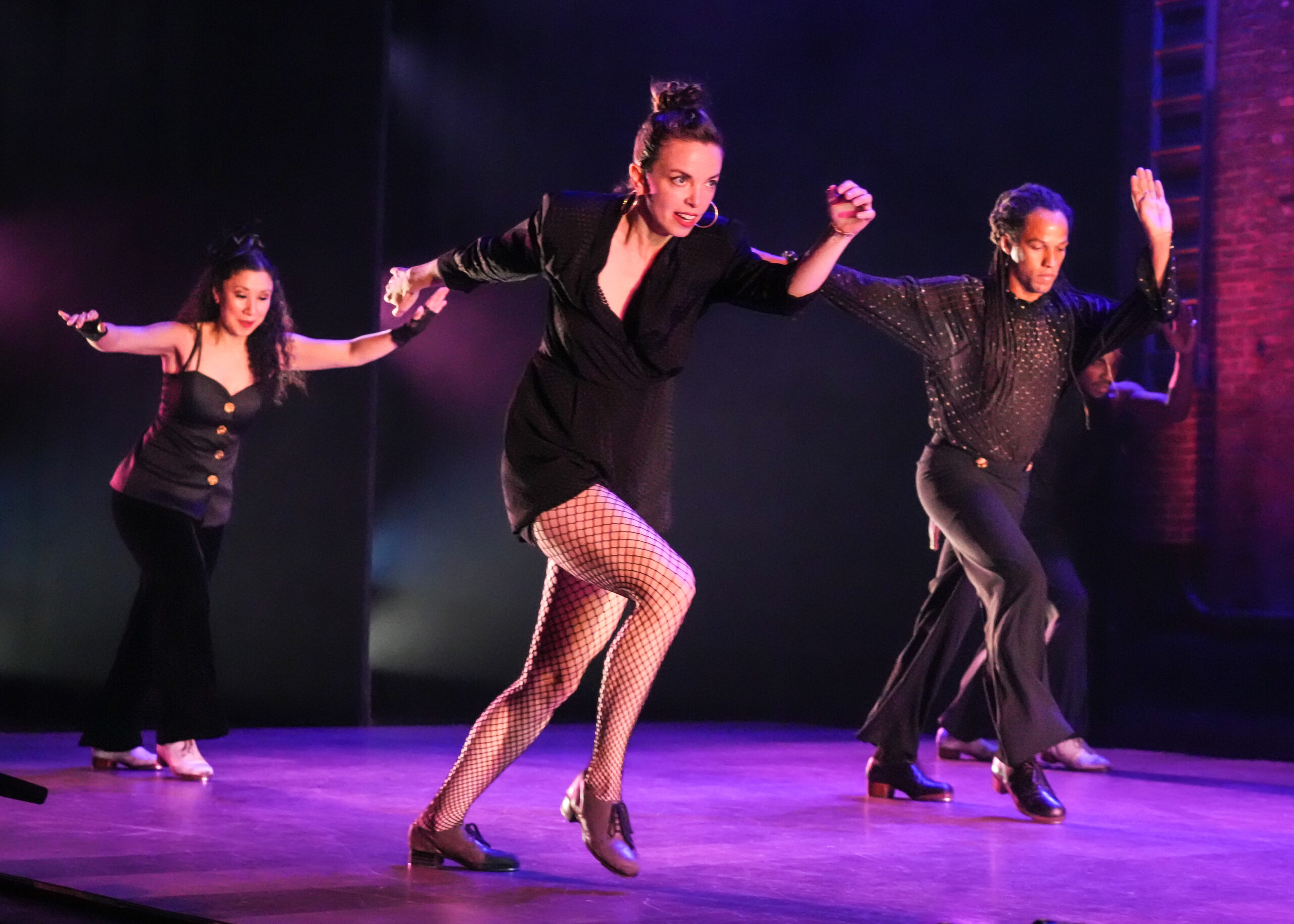
Michelle Dorrance. Photo by Richard Termine
I had the opportunity to perform quite a bit when I was young, and my mentor took our youth ensemble to these early gatherings of our elders who were the masters of the jazz era, like the last legends of the jazz era, in their 80s and 90s, when I was a teenager.
Gene took us to the St. Louis Tap Festival, where I met everyone: Jimmy Slide, Buster Brown, Prince Spencer, both of the Nicholas brothers, Peg Leg Bates, who was a huge hero. All these folks that were legends, and then, I eventually moved to New York when I was 17 and met Mabel Lee, who was a mentor of mine, a vernacular dancer, vocalist, tap dancer. My peers, folks of my generation, we are deeply committed to education, but also we’re sort of de facto historians, because we spent this time with these folks. There’s a lot of work to be done to hold on to the stories of the history of tap dance.
Michelle Dorrance. Photo courtesy of Michelle Dorrance
What brought you to Brooklyn, and what’s your favorite part of Brooklyn?
I moved to New York City in 1997. I went to NYU Gallatin, and while I was there, I first moved to Brooklyn in 1999 or 2000. I moved to Crown Heights, and I lived off the Franklin Ave. stop. That was the first time I lived in Brooklyn, and that neighborhood has changed significantly, but I love that neighborhood.
I really loved my neighbors. There was a nine-year-old upstairs that would come down and we would see Mary J. Blige together. There was probably the neighborhood’s best domino game in the foyer. It was a really special neighborhood and a special time for me.
Michelle Dorrance. Photo courtesy of Michelle Dorrance
I have moved to many different places, including the South Bronx.
When I was 27, I was in the New York City cast of “Stomp,” and that is when I really started looking for a place in South Williamsburg, right near the bridge, where I’ve been living ever since.
Michelle Dorrance. Photo courtesy of Michelle Dorrance
When you first started your career, were there many other women tap dancers?
There were, and there are. They left a huge mark on me. Diane Walker, when I was 13 years old, took us under her wing and became a real touchstone for us in the community, but also a mentor to me. I became closer with Brenda Bufalino later in my teenage years and early 20s. Diane and Brenda were huge inspirations in their generations over me.
Someone who I looked up to tremendously once I met her is Dormeshia. She was the only woman in the Broadway show bringing the noise, bringing the funk.
Michelle Dorrance. Photo by Matthew Murphy
Describe the importance for you to honor the Black American legacy of tap.
All the folks I mentioned, save Brenda, you know, are part of the Black legacy. They’re deeply living inside of the innovative legacy, stylistic legacy.
My cultural ancestors are the Black legacy of tap dance of the jazz era. I have never learned, nor am I very good at, a theatrical or whitewashed approach to tap dance, as I was also a pretty shitty ballet dancer. The tradition that I learned had so much to do with the music and feel of the dance. Of course, the aesthetic is present, but the music is first.
Michelle Dorrance. Photo courtesy of Michelle Dorrance
Tell us about your latest work, “The Center Will Not Hold.”
This is what we’re on tour with right now. It just premiered in Auburn, Alabama as a full evening work.
One of my best friends in the world is Ephrat Asherie. I asked her if she would co-choreograph a duet with me for a Dorrance Dance New York City season. It was really a gift I was giving myself, because I was working with two very different groups of folks for the other pieces in that show, and this was a piece where it was just me and my best friend. It ended up becoming a really vulnerable work that became the acorn for this larger work. What it turned into was this collaboration with an unbelievable cast of artists, everyone a titan of their respective form.
Michelle Dorrance. Photo courtesy of Michelle Dorrance
A lot of these artists touch different parts of the street and club legacy. One of these artists was in “Stomp” with me and is a dancer of the African diaspora. She trained me in “Stomp,” so to be on the road with someone I often consider my teacher is very cool. There are these unbelievable artists in this work, and everyone is a choreographic collaborator.
Michelle Dorrance. Photo courtesy of Michelle Dorrance
In these tough times economically for the arts, how do you manage to hold your company together?
The tap dancers of Dorrance Dance, some of them founding members, I’m right now encouraging them to all create work themselves in hopes that if they need a foot in the door, they can tour it alongside Dorrance Dance. The dancers I’ve been working with are unbelievable tap dancers, each of them with a singular voice.
Michelle Dorrance. Photo courtesy of Michelle Dorrance
There’s such a scarcity mindset in dance; of course, tap dance being this very eccentric and at the very bottom of the barrel part of the dance world, there’s a mindset that there’s one gig, and we all have to be a part of it. I feel quite the opposite. I think everyone needs to make work. I think people need to find their voice during this time, and so what we’re trying to do is support as much of that as possible.
SUNSET PARK — “As a resident of Marine Park, one of the great surprises I found biking around Industry City and visiting Japan Village was to discover Bush Terminal Park. I continue to be amazed at the serene hideaways that the city offers in some of the busiest places — and, still, with an iconic view.”
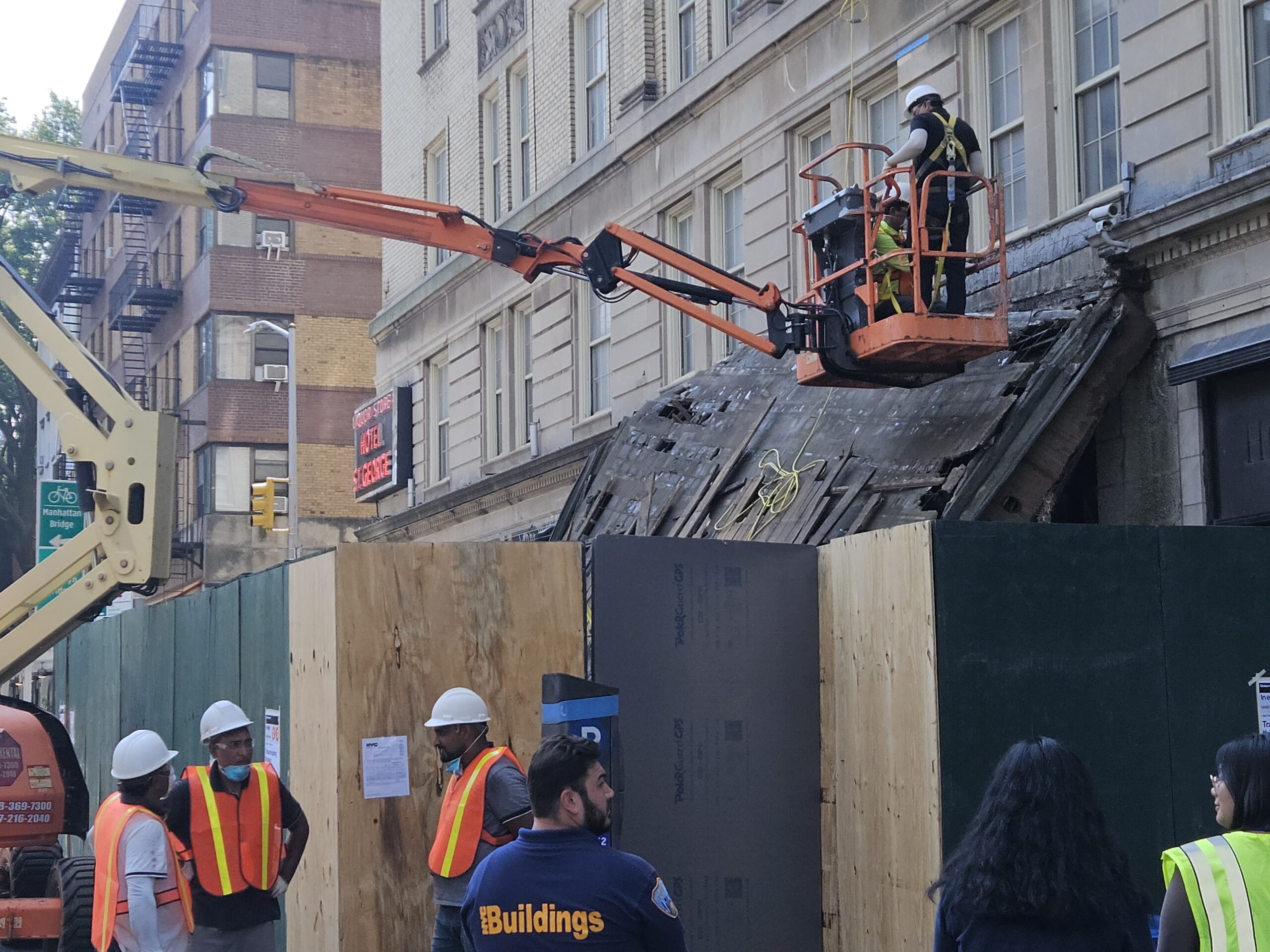
BROOKLYN HEIGHTS — ‘A miracle that no one was killed …’ That’s what neighbors are saying about the collapse of the Hotel St. George marquee. Shown in this photograph are workmen beginning the removal and repair of the historic, old neon sign at the corner, referencing a relic of Brooklyn Heights’ past: the St. George Hotel.
ATLANTIC AVENUE — Exhausted shopper with cluster of bags and goods from mall at Boerum Place stops to look at huge construction site across the street. “Is that REALLY going to be a jail??” Her male companion is reassuring, “Nothing like Rikers … this is 21st Century.”
BROOKLYN HEIGHTS — Overheard in line at one of most popular pastry outlets on Montague Street: “Hope I can get them into a camp …” A mother with two pre-schoolers in tow was showing a friend the Dodge Y flyer for Healthy Kids Day on Saturday, April 18.