Retired Supreme Court Justice Barry Kamins talks ‘Search and Seizure’ at recent CLE
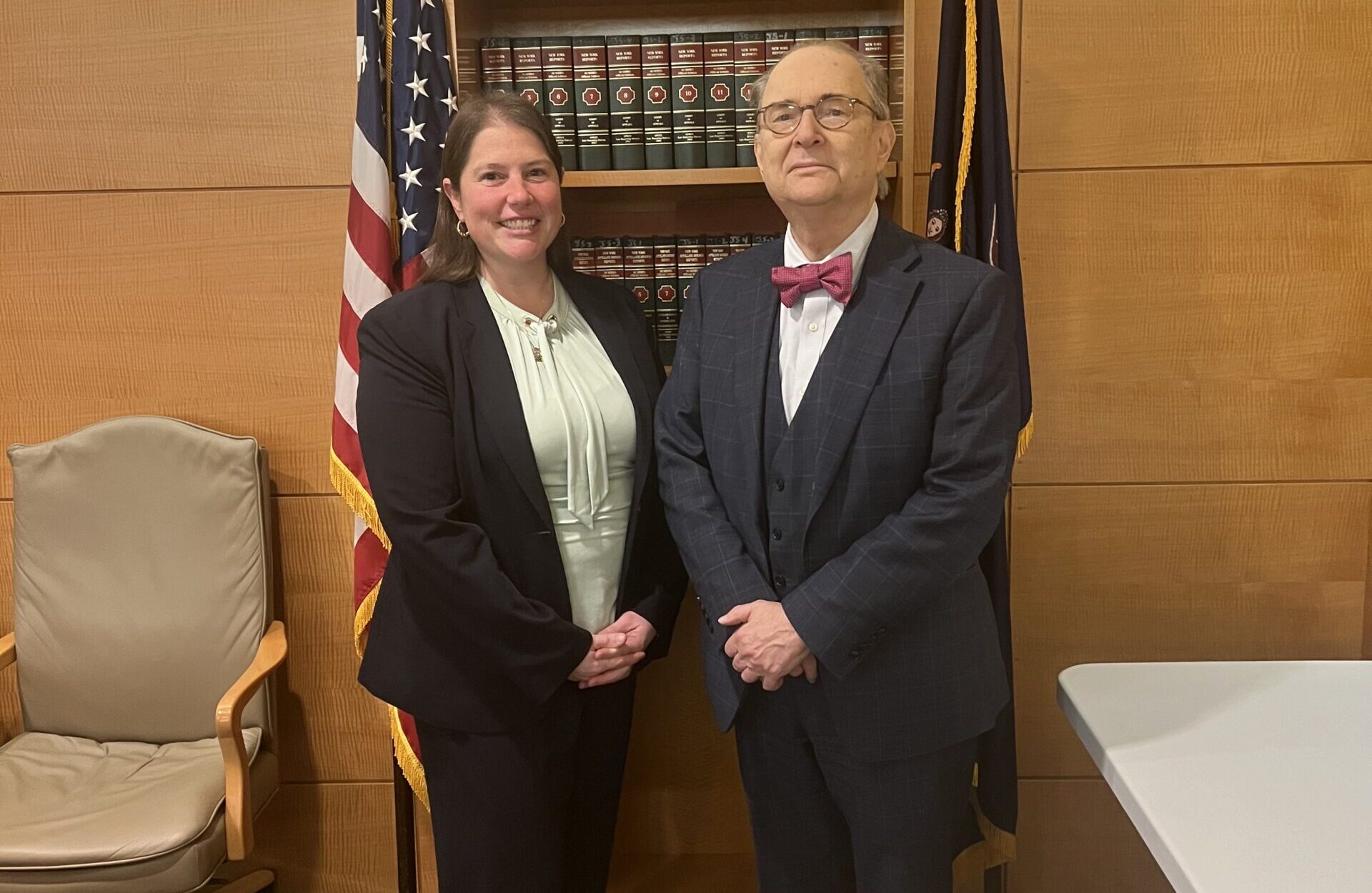
Maria Neri, Esq. alongside Hon. Barry Kamins. Brooklyn Eagle photos by Wayne Daren Schneiderman
By Wayne Daren Schneiderman
March 25, 2025
Copy Link
Email
Facebook
X
LinkedIn
WhatsApp
Telegram
Pinterest
Print
DOWNTOWN BROOKLYN — The Fourth Amendment was brought into focus as the topic of “Search and Seizure,” making for a compelling Continuing Legal Education (CLE) program from Hon. Barry Kamins on the afternoon of March 19 at Kings County Supreme Court, Criminal Term.
The event, which took place before several court attorneys, spoke to a number of cases involving search and seizure.
In the context of law, search and seizure refers to the government’s actions of examining a person’s property or belongings and taking possession of items found during that examination. The Fourth Amendment protects people from these actions, provided they are on unreasonable grounds.
But search and seizure is not always so black and white, Kamins told the Brooklyn Eagle. “This is mainly because the courts aren’t that clear about it,” he said. “There are so many different types of courts, so many levels of courts, and there could be disagreement among those courts. Ultimately, it should get decided by one court,” Kamins continued, “and in New York, that’s the Court of Appeals; federally, it would be the U.S. Supreme Court. But until that happens, you’ll have various courts making different decisions.”
Kamins also pointed out that technology is working its way into the court system in different ways when it comes to search and seizure.
“The big change is the body-worn cameras that police are wearing,” he said. “It’s having an impact. Some judges are making decisions on credibility based on what they see in the recording, despite the fact that the officers testify differently.”
Hon. Barry Kamins speaks. Brooklyn Eagle photos by Wayne Daren Schneiderman
Probable cause
Some of the more standout cases discussed at the CLE included one involving probable cause: when an officer has information from a reliable source sufficient to warrant the belief of a prudent individual that a crime is being committed.
In People v. Morell, a case from 2024, an officer allegedly observed Domingo Morell driving while he was under the influence of drugs, claiming he smelled marijuana from his clothing and that he had watery, bloodshot eyes.
The officer also alleged he observed Morell had ash containing marijuana on his pants, stating he knew the ash contained marijuana based on his professional training and prior experience in making marijuana arrests, as well as the odor coming from the substance.
Hon. Barry Kamins holding his certificate alongside Maria Neri, Esq. Brooklyn Eagle photos by Wayne Daren Schneiderman
In addition, it was alleged Morell had two puffs of marijuana before the officer stopped him. The defense argued the complaint contained no allegations that Morell’s driving was erratic, reckless or otherwise unlawful or dangerous to show he was operating the car unreasonably.
The Appellate Court agreed the complaint contained “bare-bone allegations” regarding Morell’s driving but disagreed that all classic symptoms of impairment needed to be exhibited to establish that a defendant was incapable of driving a car as a reasonable and prudent driver. They ruled the information was legally sufficient to establish Morell operated the car impaired by drugs, denying dismissal.
Hon. Barry Kamins addresses the crowd. Brooklyn Eagle photos by Wayne Daren Schneiderman
Touching upon technology
2024’s People v. Poulos touched upon technology — specifically, cellphones.
In January 2014, the Warren County Sheriff’s Department received a tip from a confidential informant that defendant Tyson Poulos,who had an outstanding arrest warrant, was selling drugs out of a hotel room.
Members of the Warren County Narcotics Enforcement Unit responded to the motel and proceeded to the room, which was registered to the defendant’s girlfriend. The defendant and his girlfriend were both present, and after allegedly obtaining the girlfriend’s consent, officers entered and searched the room, where they discovered heroin and crack cocaine, smaller quantities of other scheduled drugs, and items that appeared to be associated with reselling the drugs.
The officers also seized two cellphones from inside the motel room. In connection therewith, the defendant was charged with two counts of criminal possession of a controlled substance in the third degree, criminal possession of a controlled substance in the fourth degree, criminal possession of a controlled substance in the seventh degree, and aggravated harassment in the second degree.
Hon. Barry Kamins posing with court attorneys. Brooklyn Eagle photos by Wayne Daren Schneiderman
On June 20, 2014, the County Court issued a warrant to search the contents of the seized cellphones. The warrant was issued based on the affidavit of an investigator who received a tip from a confidential informant that drugs were being sold out of the motel room where the phones were found; that, in addition to the phones, various quantities of heroin, crack cocaine, methadone, vegetation and drug paraphernalia were seized from the motel room; and that the quantity and appearance of the drugs suggested they were packaged and intended to be sold.
Based on this information, the investigator believed the “electronic or digital contents” of the phones “may” contain information about the owner of the cell phones and evidence of the commission of drug-related crimes committed by the phones’ owner. The cell phones were subsequently searched pursuant to the warrant.
In October 2014, the defendant filed a motion to suppress the evidence obtained from that search, contending that the investigator’s affidavit did not demonstrate probable cause to believe that evidence of a crime would be found within the phones. While that motion was pending, the investigator submitted a second search warrant application for the same phones. The only difference between the first application and the second was his addition of language indicating that, in his extensive law enforcement experience, “cellphones are almost always used by the sellers of narcotics to facilitate them in their sales.”
While the investigator recounted that there was a quantity of drugs found in the motel room, along with the two phones, he did not explain why the phones likely contained evidence of a crime. Although common sense and experience might suggest that cellphones found in the same room as a quantity of drugs could potentially contain evidence related to the sale of those drugs, “common sense alone does not establish probable cause to search a person’s cellphone.”
Court attorneys at the March 19 CLE. Brooklyn Eagle photos by Wayne Daren Schneiderman
Search and seizure: always evolving
“The topic of search and seizure is always evolving,” Kamins, who is also the author of several books on the topic, explained, “Months from now, there will be even more cases to discuss.”
Kamins, a retired Supreme Court justice, was previously an administrative judge of the Criminal Court of New York City, an administrative judge for Criminal Matters for the Second Judicial District, and Chief of Policy and Planning for the New York Court System. He was appointed Criminal Court judge by former NYC Mayor Michael Bloomberg in 2008 and elevated to acting Supreme Court justice in 2009. Kamins was ultimately elected State Supreme Court Justice in 2013.
Kamins is former president of the Association of the Bar of the City of New York and formerly chaired the Advisory Committee on Criminal Law and Procedure for the Chief Administrative Judge of New York. In addition, he is a former member of the New York State Continuing Legal Education Board. He received a B.A. from Columbia College and a J.D. from Rutgers University Law School.
SUNSET PARK — “As a resident of Marine Park, one of the great surprises I found biking around Industry City and visiting Japan Village was to discover Bush Terminal Park. I continue to be amazed at the serene hideaways that the city offers in some of the busiest places — and, still, with an iconic view.”
BROOKLYN HEIGHTS — ‘A miracle that no one was killed …’ That’s what neighbors are saying about the collapse of the Hotel St. George marquee. Shown in this photograph are workmen beginning the removal and repair of the historic, old neon sign at the corner, referencing a relic of Brooklyn Heights’ past: the St. George Hotel.
ATLANTIC AVENUE — Exhausted shopper with cluster of bags and goods from mall at Boerum Place stops to look at huge construction site across the street. “Is that REALLY going to be a jail??” Her male companion is reassuring, “Nothing like Rikers … this is 21st Century.”
BROOKLYN HEIGHTS — Overheard in line at one of most popular pastry outlets on Montague Street: “Hope I can get them into a camp …” A mother with two pre-schoolers in tow was showing a friend the Dodge Y flyer for Healthy Kids Day on Saturday, April 18.