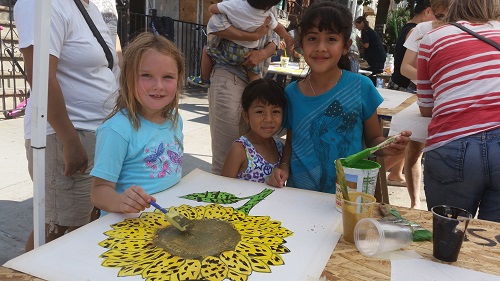
The giant sunflower could be seen from helicopters above the crowd of over 400,000 people who came from all over New York City and the world to participate in the People’s Climate March in Midtown on Sunday, September 21. Its message: “We Are The Roots That Will Weather The Storm.”
Painted by dozens of volunteers from UPROSE, an environmental advocacy group based in Sunset Park, the sunflower tarp joined a line of painted cardboard sunflowers and sunflower-emblazoned banners that were held aloft by local youth and families of all ages, who traveled by bus to be a part of what was the world’s largest march in support of climate justice and climate change awareness.
“We made art for the march – giant sunflowers – because we want to bring the community narrative to the world and let them know we’re on the frontline of climate change and we will define it, we have the solutions and we are the experts,” explained Elizabeth Yeampierre, UPROSE executive director, at one of the group’s climate change art parties held in the weeks before.
Yeampierre, who was one of the featured speakers at a pre-march press conference, continued, noting that “Art is important because art transcends people’s culture, ethnicity and race and is a unifier – a vehicle that makes it possible to come together.
“We chose sunflowers for three reasons: (1) to show solidarity with the people of Detroit who go without water, (2) to show solidarity with the people of Richmond, California, fighting petrochemical industries, and (3) because sunflowers eat up environmental toxins and produce food,” she said.
As Councilmember Carlos Menchaca noted at the art event, “[Superstorm] Sandy really hit home for anyone who was doubtful. They saw the destructive nature of climate change. It’s freed everybody up [to speak out].”
“We have a responsibility to leave a legacy for our children’s children,” added Congressmember Nydia Velazquez. “That means collaboration and a collective plan of action from leaders of industrialized countries [and] communities of color must be at the table.”
Cynthia Moices, 21, a climate justice organizer from Brownsville, agreed.
“My family understands what I do. I always relate what’s going on to Brownsville, as well,” she said. “Climate justice affects transportation, healthy food access, storm resiliency, lack of green space. . . I always let them know that Brownsville is affected by the police’s ability to respond to other events, not just hurricanes. All communities are different, but we share the fact that we’ll be the most impacted.”
Moices also said that UPROSE’s annual Youth Summit has “strengthened the solidarity among young people of color in a movement that typically has a white face. It shows that people are willing to fight for this. It will impact our generation. It’s inspiring to see.”