Albert Goldberg, a member of the Greatest Generation, said the years have quickly flown by since he saw combat in World War II 70 years ago. “It seems like yesterday to me,” the Brighton Beach resident said.
“I joined the service at 19. At 20, I was shooting Germans,” Goldberg, a US Army veteran, told the Brooklyn Daily Eagle in an interview on Tuesday. “I was a machine gunner,” he said, matter-of-factly.
His army unit was one of the first to enter Buchenwald, the infamous death camp in Germany. “You forget a lot of things over the years, but you never forget something like that,” he said, recalling the emaciated bodies, the barbed wire, and the smell of death that hung in the air.
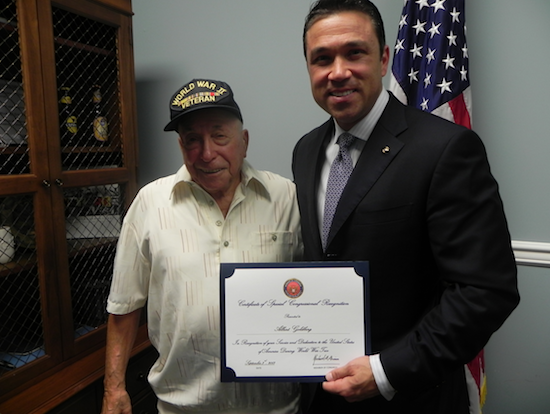
Wearing a blue baseball cap emblazoned with the words “World War II veteran,” Goldberg, 91, came to US Rep. Michael Grimm’s 13th Avenue office to receive a congressional certificate from the lawmaker, who wanted to meet him and thank him for his service to the nation. “It’s my way of saying that after all these years later, we still remember,” Grimm told the Eagle.
“It’s always an honor to have a hero in my office,” Grimm told Goldberg as he shook the elderly man’s hand. For Grimm, it was a chance to meet a fellow military veteran. Grimm (R-C-Bay Ridge-Bensonhurst-Staten Island) is a marine veteran and served during Operation Desert Storm, the first Gulf War, in 1991.
Goldberg brought his Legion of Honor Medal to show the congressman. The medal was given to American GIs by the French government in recognition of their role in liberating France from the Nazis. “I went up to West Point to get this,” Goldberg said. “Me and about 20 other guys went up there to get it. They had a ceremony for us,” he said.
Grimm seemed impressed as he looked at the medal.
Goldberg, who grew up in Bensonhurst, saw a lot of action in the war. He fought in the Battle of the Bulge. “A lot of guys were taken prisoner,” he recalled. Two GIs escaped and made their way back to their unit. They told shocking stories of the Germans killing prisoners. “At that point, General Patton said, ‘No more prisoners will be taken.’ We all knew what that meant,” Goldberg said. Gen. George Patton was ordering his men to kill the enemy rather than take them prisoner.
In 1945, Goldberg helped liberate two death camps, including Buchenwald, a place described by the website of the US Holocaust Museum as one of the largest concentration camps built by the Nazis.
“I can still smell the death,” Goldberg said. He and his fellow GIs also liberated a camp at the Austrian-Czech border.
He had wanted to enlist right after the Japanese attacked Pearl Harbor, but his parents objected. “The told me, ‘You’re not going anywhere.’ I stayed put,” he recalled. He was happy when he was drafted into the army.
At Buchenwald, he was stationed in an alleyway with his machine gun at the ready while his fellow soldiers went through the death camp, looking for survivors. He was approached by a young woman speaking a language he didn’t understand. “She wasn’t speaking German because I spoke a little German. It wasn’t French. I don’t know what she was speaking,” he said. While he didn’t understand what she was saying, he understood her gestures. She was frantically beckoning him to come with her around the corner of a building.
He followed her and she led him to a building where dozens of gypsies were being held prisoner. They were grateful to see an American GI.
Goldberg said he doesn’t feel like a hero. “If you have a job to do, you do it,” he said.
After the war, he returned home and lived with his parents for a year. “I wasn’t doing much of anything. After a year, I said to myself, ‘I’m still living with my parents. I’ve got to go out and get myself a job.’” He got a job in the shipping department at the Bulova watch company, but it wasn’t to his liking. “So I took the test for the Post Office and got that job. I worked there until I retired,” he said. He worked in the Parkville Station Post Office (11204) on 20th Avenue and 67th Street in Bensonhurst for over 40 years.
These days, Goldberg enjoys life. He goes out to dinner once a week. A particular favorite is Lorenzo’s, an Italian restaurant at the Hilton Garden Inn on Staten Island.
He doesn’t look back at his war days too often. “You do what you have to do and you move on,” he said.