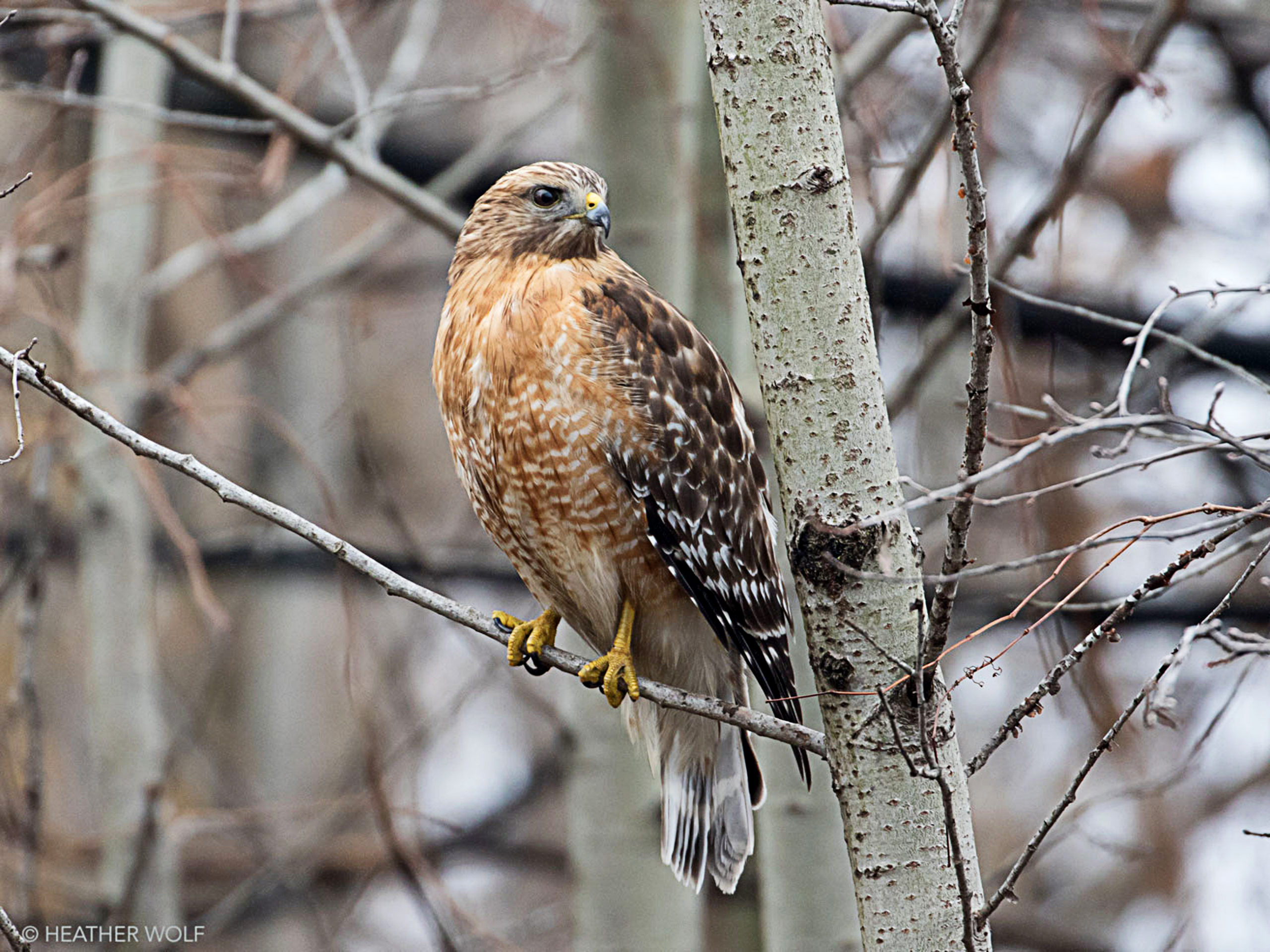
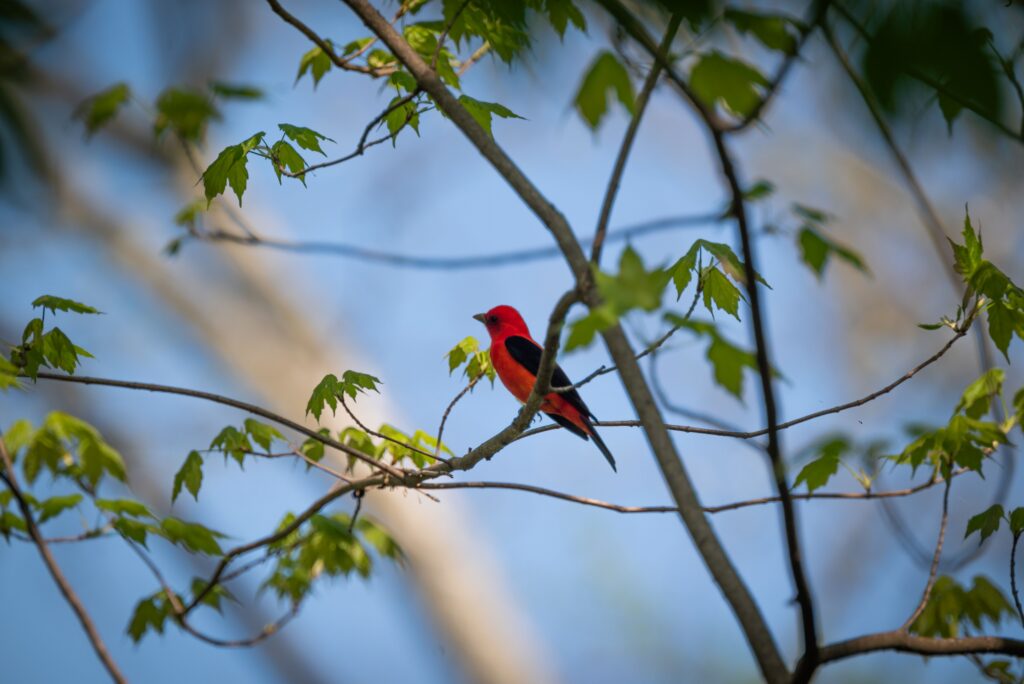
Today Brooklyn Bird Watch features a Heather Wolf photo of the Red Shouldered Hawk, a cousin to the Red Tailed Hawk, featured in Brooklyn Bird Watch back in June of 2021. Today’s photo by Ms Wolf was shot at the Marine Park Golf Course.
As the Cornell Lab notes, “Whether wheeling over a swamp forest or whistling plaintively from a riverine park, a Red-shouldered Hawk is typically a sign of tall woods and water.” As this hawk in Ms Wolf’s photo is probably doing, they are often spotted looking for prey perched in a tree along a stream or a pond.
The Red-shouldered Hawk is considered one of the most distinctly marked common hawks in North America, with barred reddish-peachy underparts and a strongly banded tail. They make a familiar whistling sound so you will know when one is near, even if you can’t see it.
A stunningly beautiful raptor in flight, the Red-shouldered hawk is easy to identify at a distance with translucent crescents near the wingtips that catch the sunlight, and a black tail with narrow white bands that fans out while the bird is soaring or gliding in the open ski. Primarily they hunt rodents, frogs, and snakes, but have been known to take on larger prey like, for instance, a pheasant. They also like to target birds and squirrels at bird feeders and like to attack from directly above the prey. Blue Jays mimic the whistle of the Red-shouldered hawk and it is presumed the jays do this to avoid predation.
Even though current populations of the Red-shouldered Hawk are stable, Wikipedia alerts us that habitat relocation caused by deforestation is definitely a potential threat to this beautiful raptor. New York is now within its breeding range and the Red-shouldered hawk is the 5th most commonly seen hawk in New York State.
Also according to Cornel, Red-shouldered hawks like to nest in the same location every year, in fact, one Red-shouldered hawk occupied a territory in southern California for 16 consecutive years. And another “Cool Fact”; by the time they are five days old, nestling Red-shouldered Hawks can shoot their feces over the edge of their nest, so, for bird lovers who may be looking for a glimpse of the hawk, Red-shouldered hawk poop on the ground is a sign of an active nest somewhere up above.
Although the Red-shouldered hawk and the American Crow steal food from each other and the crows often mob the hawk, they also work as partners to chase great horned owls from the hawk’s territory. The great horned owl is usually after the chicks of the Red-shouldered hawk but the hawk is also known to retaliate by teaming up with his mate and while he confronts the owl, she will be at the owl’s nest, stealing its chicks.
As mentioned in our last Brooklyn Bird Watch, we will periodically post links on the web to articles related to the world of birds that our Brooklyn Bird Lovers might find educational and enjoyable.
The link today is to a very thoroughly researched article by Design critic Alexandra Lange for Bloomberg CityLab, published earlier this month on January 4, 2022. Ms Lang calls attention to the growing problem of migrating birds flying into the reflective glass surfaces of skyscrapers.
The Brooklyn Eagle also reprinted a story from the Associated Press back in September of 2021 about all the shocking number of migratory birds found dead on the sidewalks of lower Manhattan after colliding with the glass skyscrapers. https://brooklyneagle.com/articles/2021/09/16/hundreds-of-migrating-songbirds-crash-into-nyc-skyscrapers/
Ms. Lange noted that there are continued efforts to highlight this problem, and also legislative efforts to approach the problem from the perspective of creating laws that govern building design. BTW, Ms Lange also devotes a few paragraphs to Brooklyn Bridge Park’s growing importance as a natural habitat for migrating birds.
https://www.bloomberg.com/news/features/2022-01-04/how-to-design-buildings-to-prevent-bird-crashes?utm_source=pocket-newtab