My father, Irving Kaufman (1910 – 1982), was a professional photographer who started in Brooklyn in the mid 1930s working for the Brooklyn Daily Eagle. He captured thousands of images of Brooklyn through the 1950s. I have recently digitized a great many of them. My father’s profile can be found here.
This week’s theme:
The photos for this week will show home front activities that supported World War II. Needless to say, the war was the dominant reality of life for Americans from before we entered WWII until well past its conclusion. That was nowhere more true than in Brooklyn. According to Thomas J. Campanella, author of last year’s masterpiece of research, writing and originality, “Brooklyn: Once and Future City,”
The war … was arguably Brooklyn’s finest hour. No place in America contributed more blood, sweat, and toil to defeating the Axis powers – nor more lives. Some 325,000 Brooklyn men and women served in the armed forces during the war, 11,500 of whom died; tens of thousands more labored in the borough’s booming defense industry, churning out everything from helmets, searchlights, and bombsights to battleships and ingredients for the atomic bomb.
From the Navy Yard at the north end of the borough down to the Army Terminal and its Port of Embarkation in the southwest, to Floyd Bennett Field at its southeastern tip, Brooklyn was enclosed by ceaseless wartime activity. Here are some highlights:
- The Navy Yard employed 70,000 people in 27 trades and professions. Within five years, they produced 17 of the most powerful warships ever built, including five aircraft carriers and three immense battleships.
- From the N.Y. Port of Embarkation at the Army Terminal, three million soldiers sailed overseas, fully half the American troops who fought in the war. A third of all the material and equipment used in the war was sent from there as well.
- Floyd Bennett Field was the site of Naval Air Station New York. As such, it was home to continuous training and coastal air patrols guarding against German submarines and protecting merchant ships. But its even greater role was the acceptance, testing, and ferrying of aircraft for delivery to combat theaters – totaling about 46,000 war planes in under four years.
Today’s photos:
These past four days supplied at least a glimpse of the many and important ways U.S. citizens on the home front – and in Brooklyn in particular – helped the war effort. None of those millions of people paid a price like the soldiers and their families did, but when the situation is grave, every little bit helps, and these “little bits” added up to a whole lot.
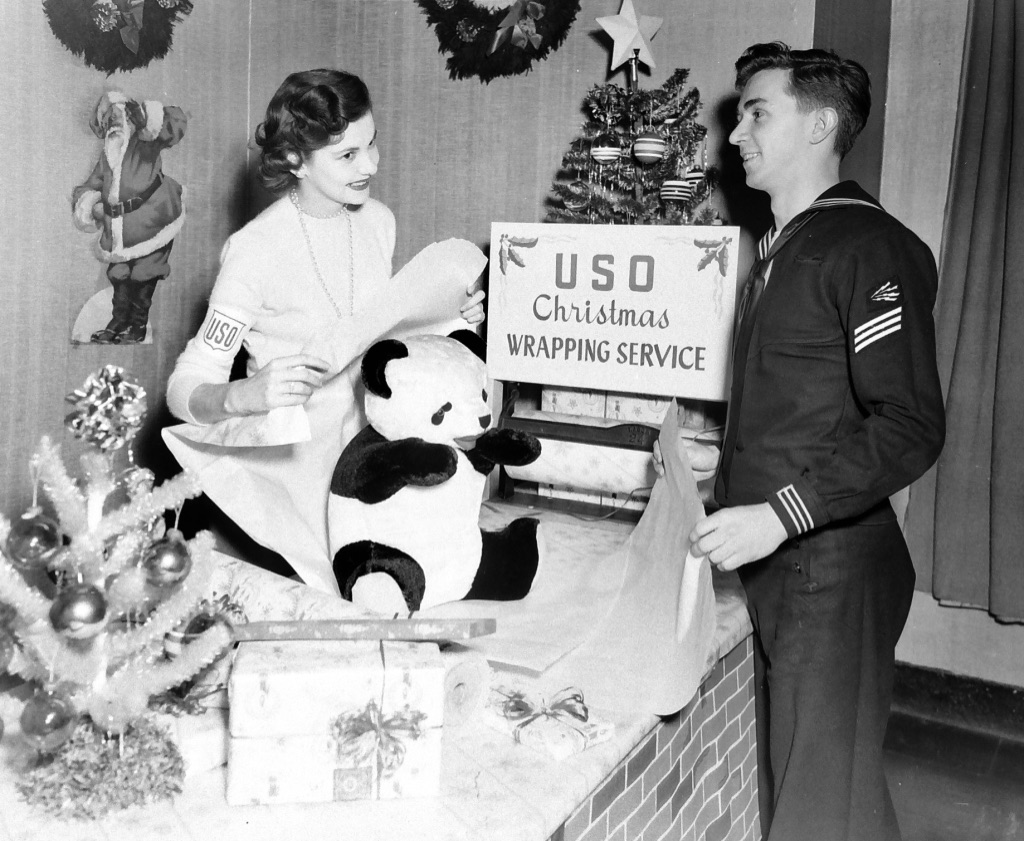
For today I’ll add a couple of pictures of one other organization in action during the war years. It was started in 1941 but has continued to serve the armed forces since that war ended. The other pictures are a few post-war shots that help us remember and look back, but with the horror and sacrifice behind us.
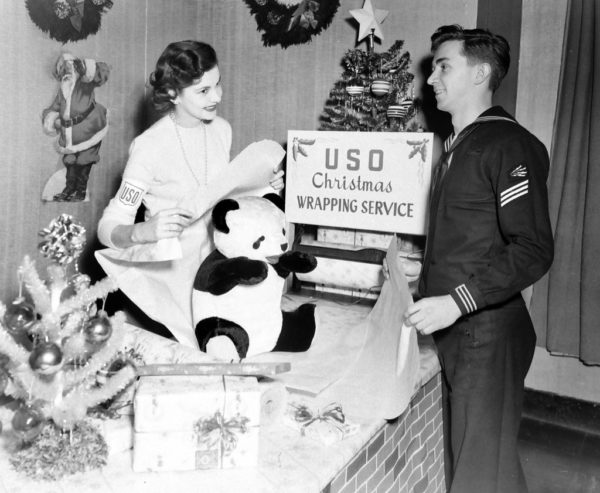
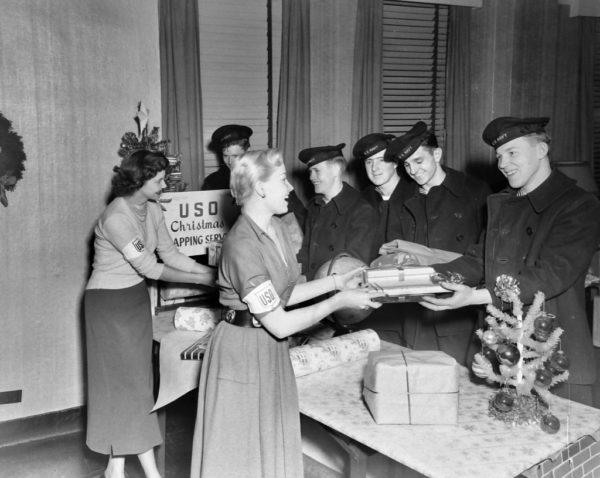
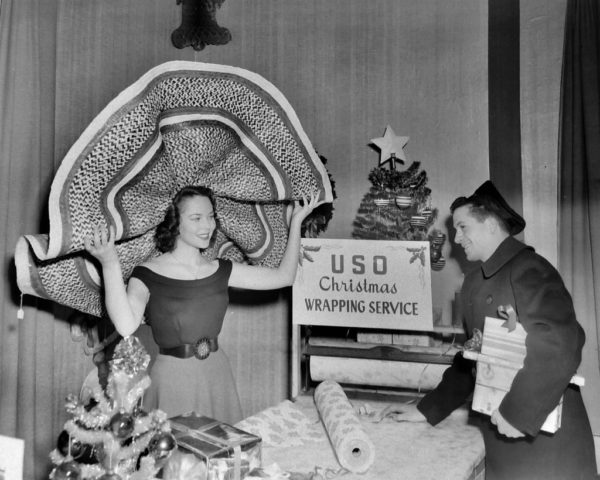
Helping sailors with a holiday task: USO volunteers wrap gifts, Brooklyn Navy Yard, December 5, 1944
The United Service Organization (USO) has worked since its inception to be a home away from home for U.S. Armed Forces. They have provided services like the gift wrapping shown here, and many others – such as social events, help adjusting to new locales, and, of course, entertainment. With almost one and a half million volunteers between 1941 and 1945, the USO was another way the nation came together to support the war, in this case by making life a little easier and even pleasant, when possible, for the people who had to do the actual fighting.
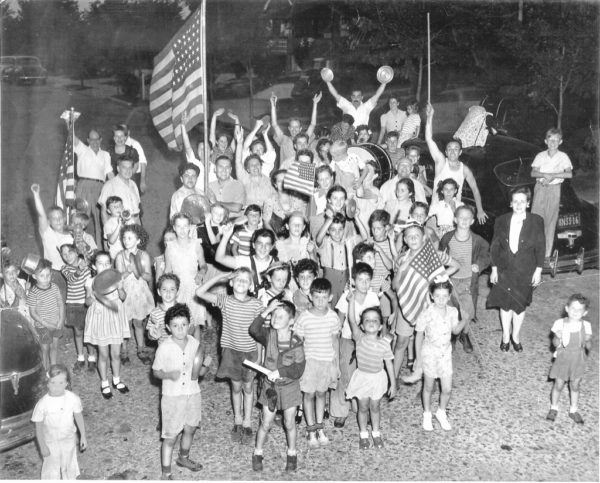
Post-war era begins now: VJ Day Celebration, 77th Place, Middle Village, Queens, August 14, 1945
The Japanese surrender, officially ending the war, was announced in Japan on August 15th. But because of the time difference, Americans heard about it when it was late afternoon on August 14th. This is how a great many streets and neighborhoods greeted the news throughout the country. Here’s how it looked, through my father’s camera, on my street exactly a year and a day before I was born. My two brothers are among the revelers.
(I posted almost the same scene to mark the 75th anniversary of VJ Day four weeks ago. But it bears repeating this week as part of the week’s topic. This shot was taken moments before or after the one shown last month.)
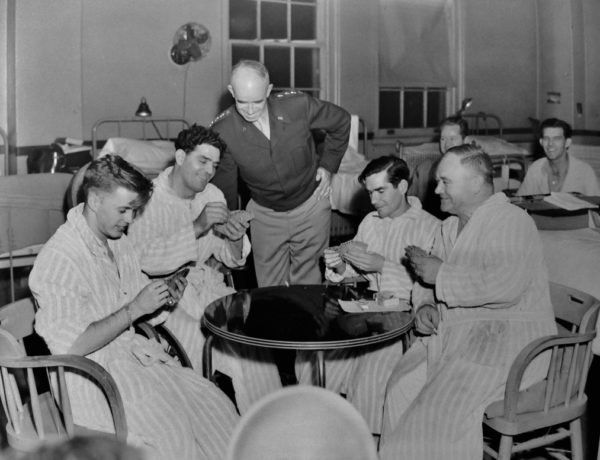
A friendly card game: General Omar Bradley looks on, February 19, 1946
Back near the beginning of my displays with the Eagle – May 12th, to be exact – I showed a picture of Omar Bradley. The theme then was interesting individual people. Here I show him, in a different context, to illustrate the ongoing war-related realities in the years after 1945. He’s smiling with a group of recuperating soldiers in a Brooklyn VA hospital.
Bradley was the most senior commander of American ground troops in Europe from the time of D-Day (June 1944) to the surrender of the Germans in May 1945. After the war, Bradley headed the Veterans Administration, and then became Army chief of staff in 1948 and chairman of the Joint Chiefs of Staff in 1949.
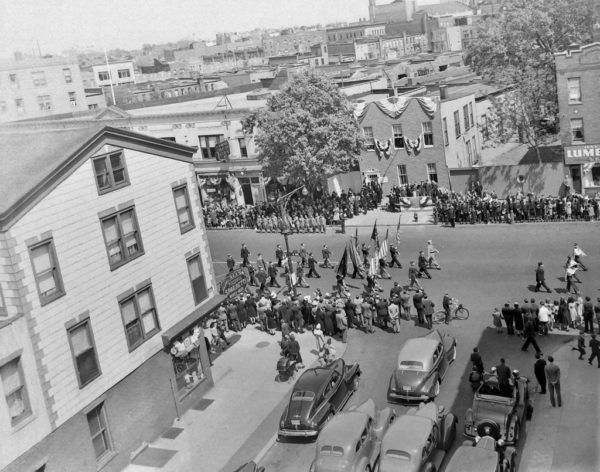
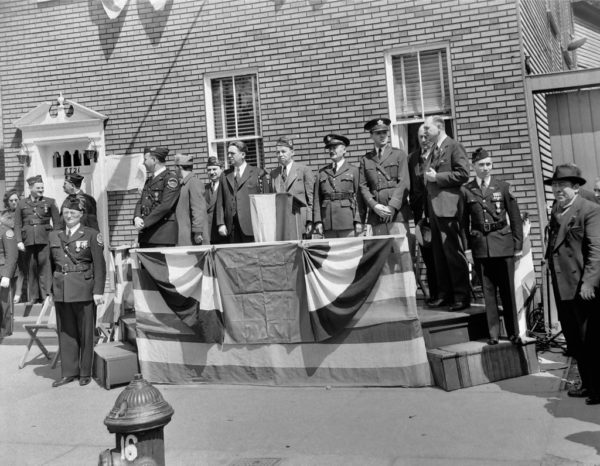
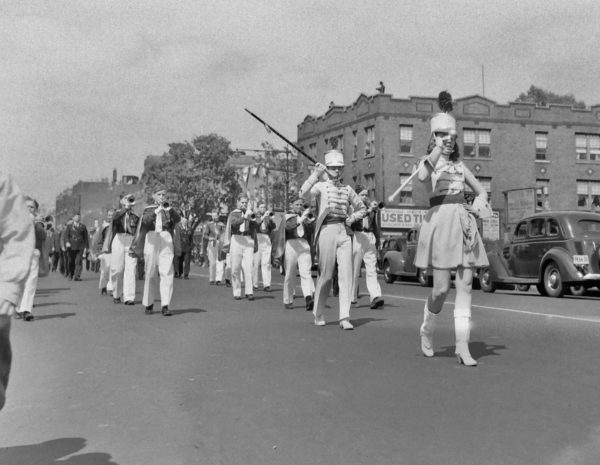
Everyone loves a parade: Jewish War Veterans (JWV), 4th Avenue, Bay Ridge, undated
The first picture shows the parade passing in front of the JWV headquarters, with bunting decorating the building and the reviewing stand in front. There seems to be quite a crowd of onlookers. Though the photo is undated, the cars indicate it’s definitely post-war, but not by more than a couple of years. So, the WWII veterans and their families have very recent memories; the older members, WWI veterans, have more distant memories, but great respect and admiration for their younger colleagues.
The second photo shows the reviewing stand, with Borough President John Cashmore in attendance (center of platform, business suit, no hat) and many uniformed veterans. The final photo gives a close look at some paraders.
An index of Kaufman’s Brooklyn posts may be found here.
Irving Kaufman’s profile may be found here.
I invite you to submit comments, memories, images of Brooklyn, and especially any additional background information you can supply about the photos posted here to [email protected]. I’d also be glad to supply information about buying prints of any of the images seen here. Many of my father’s images are also available for viewing and purchase at https://yourartgallery.com/irvingkaufmanstudios. All prints purchased will be the product of professional scanning and editing.
Weekly collection 19: Photos of ‘World War II: On the home front’