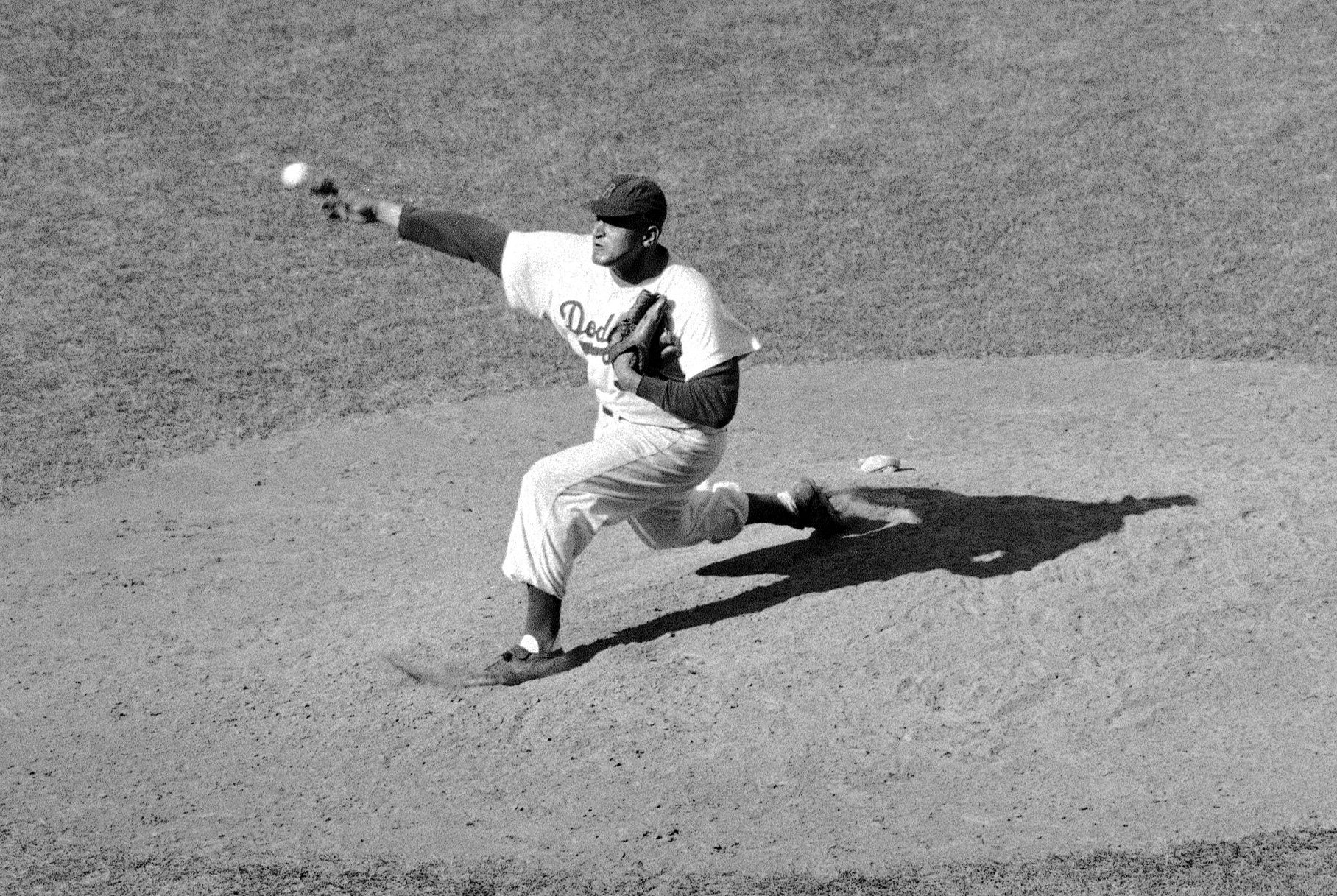
“Newk.” That’s all you needed to hear. Everyone knew who that was. Like everyone who lives in Boca Raton, FL, says they live in Boca, never Boca Raton, no one who followed baseball in the ‘50s ever called him Don Newcombe. Newk made being a Dodger fan in 1955 something unforgettable, but we get ahead of ourselves.
My choice for the June article (he was born June 14, 1926), Newk came up from the Negro leagues a flame-throwing hot prospect. He came up after Campanella (another one-namer—Campy). That made sense. There was still racism, still nastiness, and still a paucity of players who looked like you if you were Black. Campanella knew the pitchers. Like any good catcher, he knew his pitchers inside and out. He knew when and what to say in a tight spot. He knew when not to say anything. He was the key that opened up Newk. Cited in The Athletic, Carl Erskine said that Newcombe and Campanella had a bond, that Campanella knew how to pace Newcombe, and turned him into a complete pitcher.
He also knew the stress on a man when he was one of only a few Negro ball players of his day, the third Black pitcher to come up from the Negro Leagues.
To say that Don Newcombe was an all-round athlete is to sell the man short. First, he was an imposing figure at 6 feet 4 inches tall and weighing 220-240 pounds. He was a hard thrower. Carl Erskine estimated the Newcombe fastball at upper 90s. He threw basically two pitches, a fastball and a slider. It was his pinpoint control that was the icing on the cake. And he could hit. He was such a good hitter that he was used as a pinch-hitter. He had power, hitting 15 home runs in his career, hitting two in one game against Pittsburgh. He even pinch ran and stole a base or two.
Was he strong? You tell me. On September 6,1950, he pitched both ends of a doubleheader against the Philadelphia Phillies. The Society for American Baseball Research reports that he pitched a 2-0 shutout in the first game and needed only 83 pitches to do it. In the second game, Bleacher Report states, Newcombe allowed only two runs in seven innings, and the Dodgers rallied for a win in the ninth inning.
But America was at war, and like so many ball players, Newcombe enlisted, giving two valuable years of his prime to the nation he loved.
In ’55, Newk was back, but he had to re-establish himself. On his return, his manager, Charley Dressen, had his doubts. Newcombe dispelled them. He won his first outing and just kept on winning. Win after win. Brooklyn fans went nuts for Newk. With every win, there was jubilation and also more pressure for the next outing. He went 11-0. I’ll never forget being glued to the TV when I could, or driving my mother crazy by grabbing the NY Post and flipping it over because the sports pages were in the back of the paper, to read about his heroics. I soaked up everything Newcombe.
There was a particular game when it looked like his streak would end at 7. This is how SABR described how he pulled it out: “Newcombe demonstrated his prowess on several dimensions that afternoon: winning his eighth consecutive decision with a complete game and nine strikeouts, hitting two homers, and participating in three double plays. He regained his ace status that summer, leading Dodgers pitchers with a 20-5 record and a 3.20 ERA over 233⅔ innings. He set the NL record for the most home runs in a season by a pitcher (7), finished seventh in the MVP voting, and received a championship ring when Brooklyn was crowned World Series winners.”
But there was another side to this strong man. Erskine said that his off-the-field deeds were worth more than his fastball. He was involved in charity work and his teammates’ lives. He helped guide an alcoholic Maury Wills, into treatment, and Wills credits Newcombe with saving his life.
Yet he had his own demons, a ferocious temper, being stubborn as a mule, and liking the bottle too much. There was incredible stress on a man when he was one of only a few Negro ball players of his day. He was only the third Black pitcher to come up from the Negro Leagues. Like TG Sheppard sang, “There’s a devil in the bottle and Lord he wants me dead.” Those lyrics are also part of the Don Newcombe story. Here it is in his own words.
“I was a big, strapping baseball player, a part of history,” reported the Mercury News covering Newcombe’s address at Diablo Valley College one spring evening. “I was changing society for black folks, along with Jackie Robinson and Roy Campanella.”
One day, he found himself “kicked out of baseball.” Blame it on the bottle.
“I could not, would not stop drinking,” he said. “The only thing I wouldn’t give up was my family.”
He did the admirable thing. He got sober and began counseling abusers. It was an interesting time to be discussing athletes and their addictions. Mets star Dwight Gooden was battling demons. Len Bias was taken by the Celtics with the second pick of the NBA draft. Two days later, he was dead. Cocaine. The Warriors were trying their best to keep Chris Washburn on the straight and narrow, according to The Mercury News.
In his obit of Newcombe, George Vecsey wrote that not enough had been written about how this strong man beat his alcoholism. He said Newcombe became a spokesman for sobriety. He offered himself as a prime example, how he had wrecked his career as a pitcher (and pinch-hitter deluxe), by drinking. He gave testimony of how he had gone sober, on his knees, promising his wife he would never drink again. The amazing thing about this tough guy is that he did it by himself—just stopped. Most alcoholics rely on daily reinforcement, the meetings, the written word, and the prayer to a higher power. Newk just stopped. This guy was so tough, he would not take gas or be injected at the dentist to deaden the pain. He never went to a rehab center, never went to AA meetings for himself, but he did recommend that path for anybody else. He told other people that rehab worked, and that they should seek it, and sometimes he accompanied them right into the center.
According to New Jersey’s Patch publication, he was a national spokesperson and consultant for the National Institute on Alcohol Abuse and Alcoholism. He also served as a consultant for the New Beginning Alcohol and Drug Treatment Program and as the director of special projects for Recovery Centers of America.
Depending on which Don Newcombe was pitching in a given year, he was either very good or often very bad, so his statistics tell an uneven story. In his ten-year career with the Dodgers, he had 153 wins against 158 losses with an ERA of 3.57. Twenty-four of those wins were shutouts. But he completed 145 games, racking up 1,187 strikeouts. He was the first pitcher to be named Rookie of the Year and win the first Cy Young Award.
“Patch” of Madison, NJ, Newcombe’s hometown, went on to say that in ’55 and ’56, “Newcombe hit a combined .298, with nine home runs and 16 extra base hits. During his career with the Dodgers, the Cincinnati Reds, and the Cleveland Indians, Newcombe won 163 games and had a stellar .614 winning percentage. Newcombe could always wield the lumber; his batting average for his 12-year Major League Baseball stint was .269 with 52 extra base hits that included 15 home runs.”
Unlike his teammates Robinson and Campanella, who died young, Newcombe lived a long life, dying in California at age 92. Before that time, I almost fulfilled as an adult a boyhood dream. I knew Newcombe’s lawyer, Willie Gary. In a meeting we had, I saw Newk’s picture on Gary’s desk and inquired. He said, “He’s my client, would you like to meet him?” I told him my boyhood stories. He said Newcombe was coming for a visit, and he would arrange for me to come into the office and eat lunch with them. It never happened.
I never got the meet, it was Newk’s 92nd year, but I can say this: “Newk — you’re long gone but not ever forgotten.”