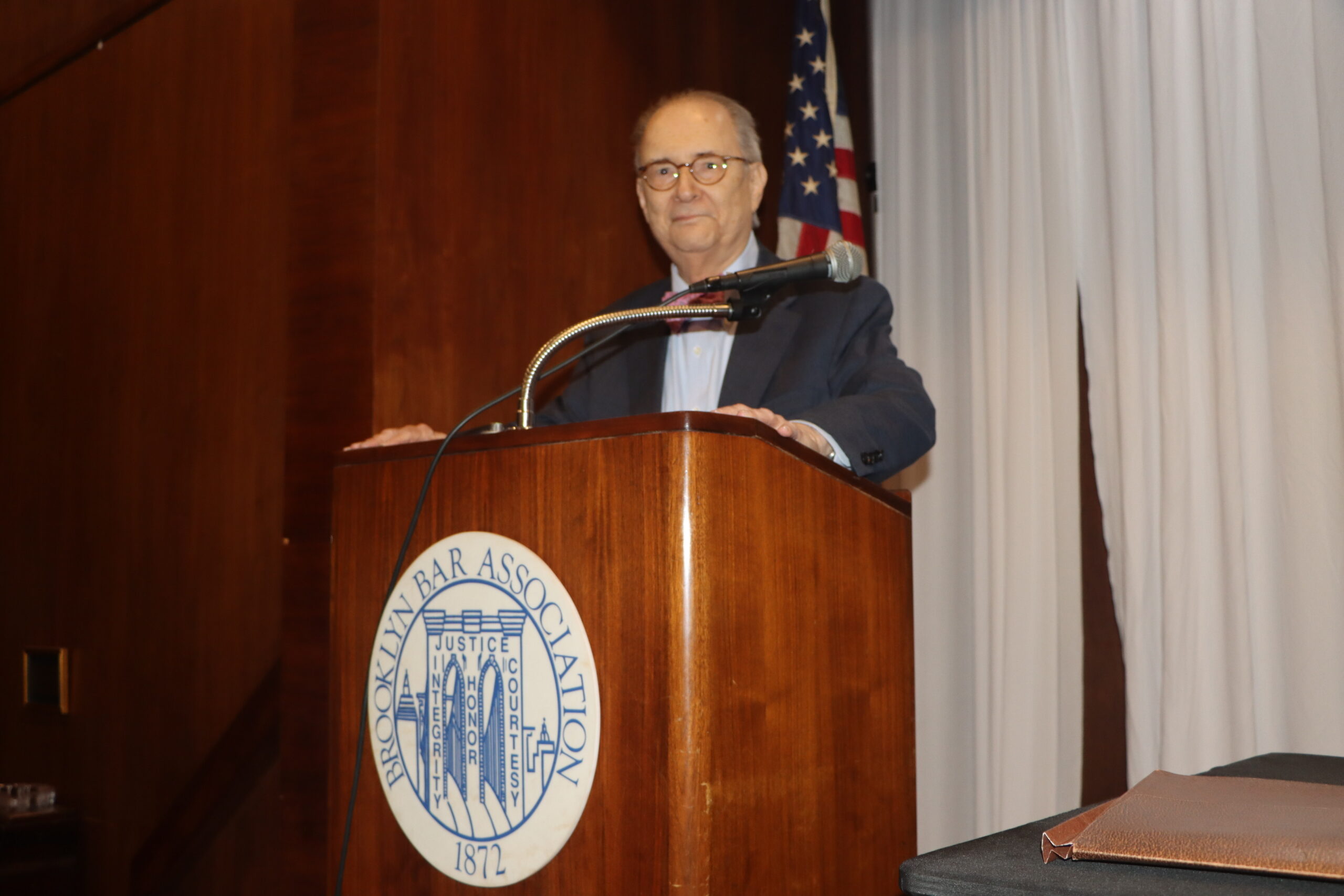
BROOKLYN HEIGHTS — The Kings County Criminal Bar Association, a community legal organization dedicated to the improvement of the criminal justice system in Brooklyn, hosted a “Search and Seizure” CLE presented by Hon. Barry Kamins, the author of several books on the topic.
The event took place at the Brooklyn Bar Association’s historic headquarters, 123 Remsen St., the evening of May 14.
In the context of law, search and seizure refers to the government examining a person’s property or belongings and taking items found during that examination, which are protected by the Fourth Amendment.
Kings County Criminal Bar Association President and attorney Michael Sheinberg. Photo: Mario Belluomo/Brooklyn Eagle
“The topic of search and seizure is always evolving,” Kamins said.
In his presentation, Kamins touched upon several new developments, including the Court of Appeals lessening its standard for stopping individuals based on anonymous tips.
“The New York Court of Appeals has, over time, become somewhat more permissive about these types of police stops than in earlier cases like People v. De Bour,” Kamins explained.
People v. De Bour created a four-level framework governing police encounters, which includes a request for information, a common-law right of inquiry, stop-and-frisk and arrest.
Its modern impact is substantial because New York courts still use De Bour in suppression hearings. Evidence — guns, drugs, statements, etc. — can be thrown out if police escalated an encounter without the required level of suspicion.
Geofence warrants and iCards
Kamins also spoke to Supreme Court arguments on the use of “geofence” warrants, which he described as “warrants that permit law enforcement to examine cell phone accounts of everyone in a certain geographical area during a specific time period in order to find the perpetrator of a crime.”
The People v. Mangano was cited as one of the key New York trial-level cases dealing with geofence warrants. In “Mangano,” police investigating a serious crime obtained a geofence warrant requiring Google to provide location data for every device in a defined geographic area and within a specific time window.
The defense argued that it was a “reverse warrant,” searching everyone first, then finding suspects, violating the Fourth Amendment’s particularity requirement.
The prosecution argued that the warrant was limited by time and geography. The court ultimately allowed the geofence evidence, finding that the warrant was sufficiently particularized in scope and the procedure did not automatically violate the Fourth Amendment.
Even though it is not a Supreme Court case, “Mangano” is important today because it shows how lower courts are currently handling geofence warrants.
Kamins addressed iCards, a written record officers complete when they stop or question someone on the street, conduct a frisk or make an arrest in connection with a stop. They are directly tied to search and seizure law because they document and help justify the street encounters governed by the Fourth Amendment and the People v. De Bour framework.
Today, iCards function as constitutional accountability records and data sources used for pattern-and-practice analysis and litigation in Fourth Amendment cases. They are also part of why the stop-and-frisk law in New York is heavily documented compared to many other jurisdictions.
“I firmly believe that iCards will most certainly change a lot of protocols in the District Attorney’s office,” Kamins said.
Probable cause
“Courts are always tinkering with this formula, as far as what is probable cause,” Kamins said of probable cause. “You’ve got to have very certain, specific factors.”
Kamins cited McCray v. Illinois, a case involving defendant Willie McCray, where police officers received information from a confidential informant that McCray was selling narcotics. The officers knew the informant from prior dealings and testified that the informant had proven reliable in the past. Police arrested McCray and found heroin.
In the end, the Supreme Court held that police may establish probable cause based on information from a reliable confidential informant without necessarily revealing the informant’s identity in court. This became an important rule in Fourth Amendment law.
Attorney feedback
Legal professionals in the room shared their thoughts on Kamins’s presentation.
William Neri, Esq. Photo: Mario Belluomo/Brooklyn Eagle
Kings County Criminal Bar Association President and attorney Michael Sheinberg said that Kamins “did a fantastic job.”
“Things change so fast in the legal world regarding Search and Seizure,” Sheinberg said. “This is really something that defense attorneys and prosecutors should be listening to. Barry is a wonderful presenter and a total expert on the subject.”
Darran Winslow, Esq., echoed those sentiments: “Any chance I get to hear Judge Kamins is a chance to become educated. He’s fantastic.”
Winslow added that every time he observes Kamins in action, it improves how he approaches his practice.
Kamins, a retired Supreme Court justice, was previously administrative judge of the Criminal Court of New York City, administrative judge for Criminal Matters for the Second Judicial District and chief of Policy and Planning for the New York Court System.
He was appointed Criminal Court judge by former NYC Mayor Michael Bloomberg in 2008 and elevated to acting Supreme Court justice in 2009. Kamins was ultimately elected State Supreme Court Justice in 2013.
The retired judge is also known for his unique sense of style — most notably, his signature bow ties, which he told the Brooklyn Eagle he acquired a taste for when he was in private practice.
SUNSET PARK — “As a resident of Marine Park, one of the great surprises I found biking around Industry City and visiting Japan Village was to discover Bush Terminal Park. I continue to be amazed at the serene hideaways that the city offers in some of the busiest places — and, still, with an iconic view.”
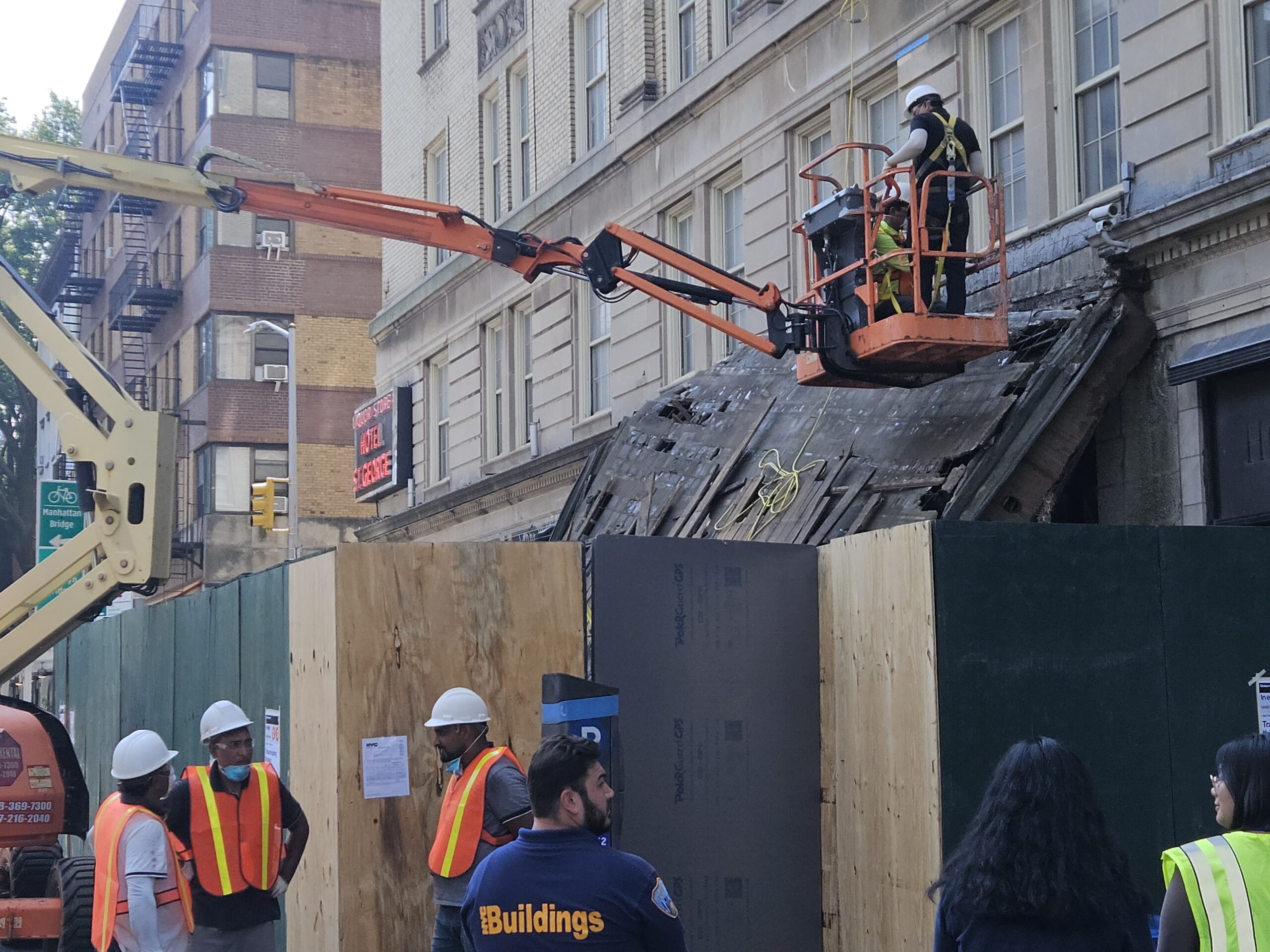
BROOKLYN HEIGHTS — ‘A miracle that no one was killed …’ That’s what neighbors are saying about the collapse of the Hotel St. George marquee. Shown in this photograph are workmen beginning the removal and repair of the historic, old neon sign at the corner, referencing a relic of Brooklyn Heights’ past: the St. George Hotel.
ATLANTIC AVENUE — Exhausted shopper with cluster of bags and goods from mall at Boerum Place stops to look at huge construction site across the street. “Is that REALLY going to be a jail??” Her male companion is reassuring, “Nothing like Rikers … this is 21st Century.”
BROOKLYN HEIGHTS — Overheard in line at one of most popular pastry outlets on Montague Street: “Hope I can get them into a camp …” A mother with two pre-schoolers in tow was showing a friend the Dodge Y flyer for Healthy Kids Day on Saturday, April 18.