The intern who never gave up: Building a career inside Brooklyn’s courthouses
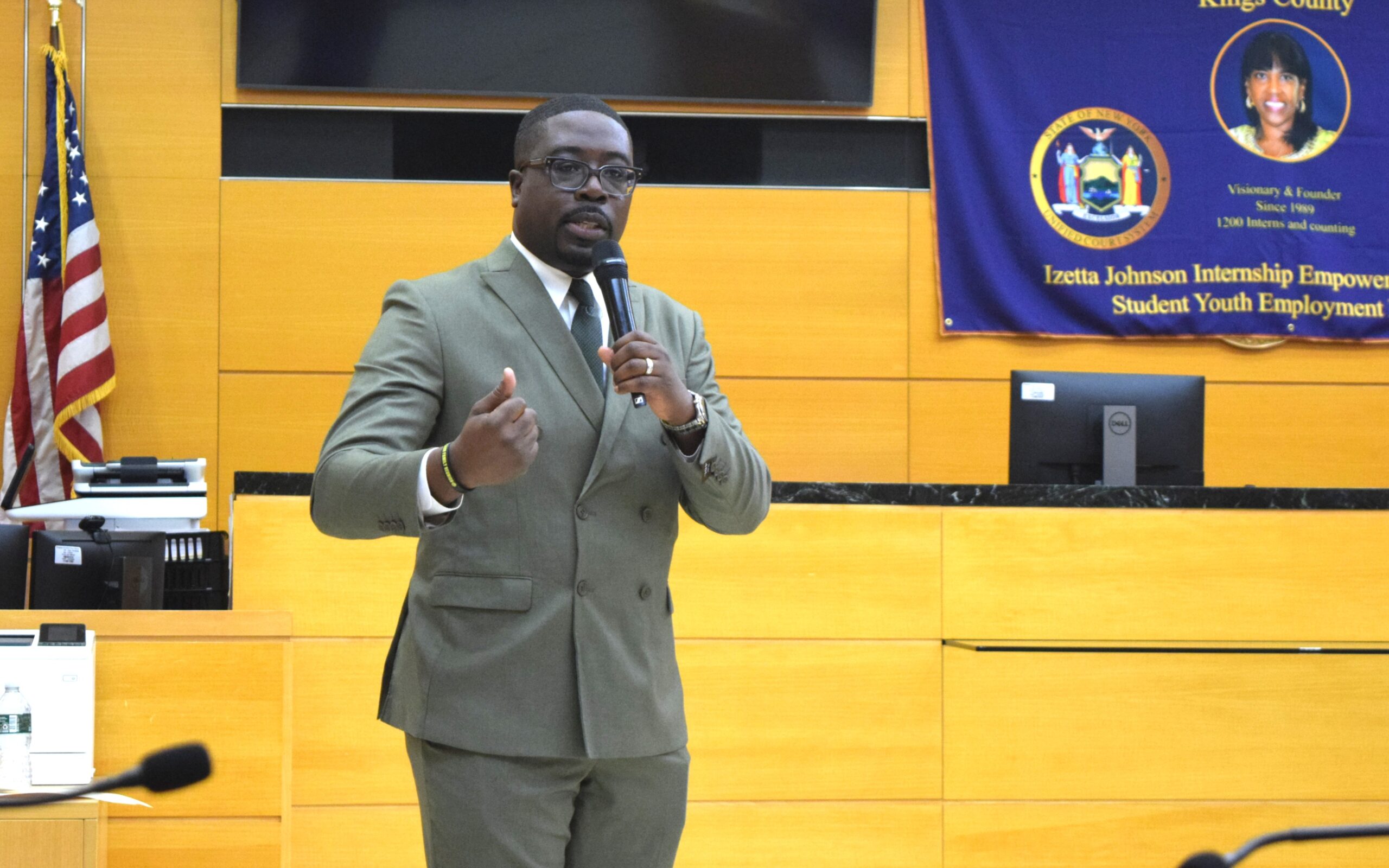
Xavier Carr, senior counsel at the New York City Office of Technology and Innovation, speaks to Summer Youth Employment Program interns at Kings County Supreme Court, Criminal Term, on Tuesday. Carr shared his personal journey from unpaid intern to city attorney and encouraged students to take their roles in the courthouse seriously. Brooklyn Eagle photo by Robert Abruzzese
DOWNTOWN — When Xavier Carr stood before a group of Summer Youth Employment Program interns at Kings County Supreme Court, Criminal Term, on Tuesday, he was speaking from experience: about failure, resilience and building a career from the ground up.
Years earlier, Carr had started his own legal career just across the street, at the Civil Term. He was already a law school graduate when he began interning there, broke, exhausted and unsure of what came next.
He had just failed the bar exam, again. He had a child to support and bills to pay. Still, he turned down paying legal work to return to the courthouse, unpaid, because he believed the experience would lead to something more.
“There were a lot of challenges that I faced during the bar exam,” said Carr, who admitted to the interns that it took him six attempts to finally pass. “I was trying to navigate becoming a new father, trying to battle with, ‘Hey, do I go work a nine-to-five or study for the bar?’ But I knew at the time I had to get past the bar so I could make sure that I would be able to take care of my family and myself.”
Friends told him he was wasting his time. Some even suggested that working for free was a sign of failure. But Carr believed he was investing in himself.
“You have to know it’s your path; it’s your walk, and it’s on you to create the opportunities you want,” Carr told the students. “You’re not always going to get the celebratory reaction from your friends and family. But that can’t be the measure of your decisions.”
Interns listen to Xavier Carr’s remarks inside the ceremonial courtroom at 320 Jay Street. Carr urged students to be proactive, stay prepared and take advantage of every opportunity. Brooklyn Eagle photo by Robert Abruzzese
Carr, now a senior counsel at the New York City Office of Technology and Innovation, was raised between Brooklyn and New Jersey by a working-class family with no ties to the legal profession. He was the first in his family to pursue a law degree and had to learn the process largely on his own.
He began college at Morehouse in Atlanta, drawn to its legacy of Black leadership, before transferring to Rutgers University, where he earned a degree in political science and philosophy. After applying to 19 law schools and receiving only one acceptance, he enrolled at Thomas Jefferson School of Law in San Diego.
Returning to New York after graduation, Carr took an unpaid internship with Justice Kathy King in the Kings County Supreme Court, Civil Term. That first step led to positions as assistant law clerk and senior law clerk, eventually culminating in his appointment as principal law clerk. Over the course of several years, he gained hands-on experience in legal writing, motion practice, trial scheduling and courtroom operations.
In 2022, Carr joined the Office of Technology and Innovation, where he now handles contracts, regulatory compliance, employment matters and internal investigations affecting city agencies. He credits the courthouse and the mentors he met there with preparing him for the work he does today.
At Tuesday’s program, hosted inside the Criminal Term courthouse at 320 Jay Street, Carr returned to that early chapter of his career not to relive past struggles, but to offer a roadmap to those just starting out.
Xavier Carr, senior counsel at the New York City Office of Technology and Innovation, speaks to Summer Youth Employment Program interns at Kings County Supreme Court, Criminal Term, on Tuesday. Carr shared his personal journey from unpaid intern to city attorney and encouraged students to take their roles in the courthouse seriously. Brooklyn Eagle photo by Robert Abruzzese
The Summer Youth Employment Program places high school and college students in internships throughout the court system each year, giving them a first look at the legal profession. Carr told them that the most important thing they could do now was show up, stay prepared and be open to opportunities, even when they don’t come with a paycheck.
“Working in the court was where I learned how law actually functions,” Carr said. “Law school teaches you to think like a lawyer, but being in chambers — watching judges rule, watching attorneys argue, writing memos, reviewing motions — that’s where I learned how to practice.”
Carr’s turning point came when Judge Wavny Toussaint offered him a position as a clerk after learning he had passed the bar. From there, Carr steadily advanced through the system. Over the years, many of the judges he once worked alongside as fellow court attorneys were elevated to the bench, and those relationships, he said, proved just as valuable as any credential.
Justice Deborah Dowling introduced Carr at the event and spoke about the example he set for young professionals trying to find their footing.
“He’s a young man who worked in the court system and is now in a big-time job with the City of New York,” Justice Dowling said. “He knows this courthouse; he knows law school, and he’s going to share not just his experiences, but also some of the mistakes he made along the way.”
From left: Jennifer Joly, Hon. Deborah Dowling, Xavier Carr and Nicole Smith at Tuesday’s Summer Youth Employment Program event at Kings County Supreme Court, Criminal Term. Brooklyn Eagle photo by Robert Abruzzese
Carr urged the interns to take their time in the courthouse seriously, no matter how minor the task might seem. He encouraged them to be proactive, to learn from everyone around them — not just judges and attorneys, but clerks, officers and staff — and to treat every assignment as a chance to grow.
“Be early, be prepared and don’t wait to be told what to do,” he said. “If you finish something, ask what else you can help with. If you see something on the calendar that you don’t understand, look it up.”
He also told them not to be intimidated by titles or discouraged by setbacks. He shared that many of the judges he now works with were once interns and clerks just like them. What mattered most, he said, was consistency, professionalism and humility.
“You never know who’s watching,” Carr said. “And you never know who you’ll be working alongside five or ten years from now. Some of the people I sat next to as a law clerk are now on the bench. That’s how this place works.”
He also reminded students that the legal field is broad, and their careers may not unfold exactly as planned. Carr said he never expected to work in technology, but that his courtroom training gave him the tools to pivot and to make an impact in a different part of city government.
Robert Abruzzese, Esq., is admitted in the Appellate Division, Second Department, serving as law clerk to Justice Wayne Saitta in Kings County Supreme Court. He was the Courthouse Editor of the Brooklyn Daily Eagle. The views expressed here do not reflect those of the court or the judiciary.
Robert Abruzzese, Esq., is admitted in the Appellate Division, Second Department, serving as law clerk to Justice Wayne Saitta in Kings County Supreme Court. He was the Courthouse Editor of the Brooklyn Daily Eagle. The views expressed here do not reflect those of the court or the judiciary.
SUNSET PARK — “As a resident of Marine Park, one of the great surprises I found biking around Industry City and visiting Japan Village was to discover Bush Terminal Park. I continue to be amazed at the serene hideaways that the city offers in some of the busiest places — and, still, with an iconic view.”
BROOKLYN HEIGHTS — ‘A miracle that no one was killed …’ That’s what neighbors are saying about the collapse of the Hotel St. George marquee. Shown in this photograph are workmen beginning the removal and repair of the historic, old neon sign at the corner, referencing a relic of Brooklyn Heights’ past: the St. George Hotel.
ATLANTIC AVENUE — Exhausted shopper with cluster of bags and goods from mall at Boerum Place stops to look at huge construction site across the street. “Is that REALLY going to be a jail??” Her male companion is reassuring, “Nothing like Rikers … this is 21st Century.”
BROOKLYN HEIGHTS — Overheard in line at one of most popular pastry outlets on Montague Street: “Hope I can get them into a camp …” A mother with two pre-schoolers in tow was showing a friend the Dodge Y flyer for Healthy Kids Day on Saturday, April 18.