✰PREMIUM Tree guards support NYC’s urban forest agenda
The city partners with Big Reuse to make ‘tree guards’ a commonplace protective measure
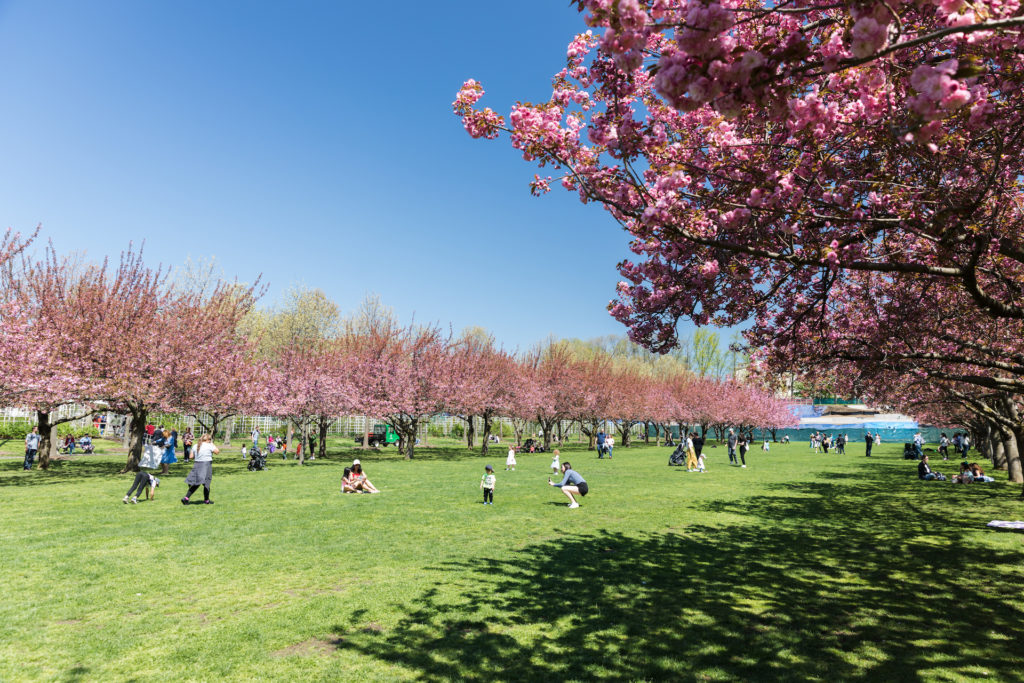
The Brooklyn Botanic Garden’s cherry trees are known worldwide. Eagle file photo by Paul Frangipane
By Clark Adomaitis and Mandie-Beth Chau
March 2, 2025
Copy Link
Email
Facebook
X
LinkedIn
WhatsApp
Telegram
Pinterest
Print
Big Reuse, a Gowanus-based environmental nonprofit, and Councilmember Lincoln Restler (D-33) have launched a do-it-yourself tree guard project. The project is one of many community and city initiatives to support a newly-launched urban forest plan.
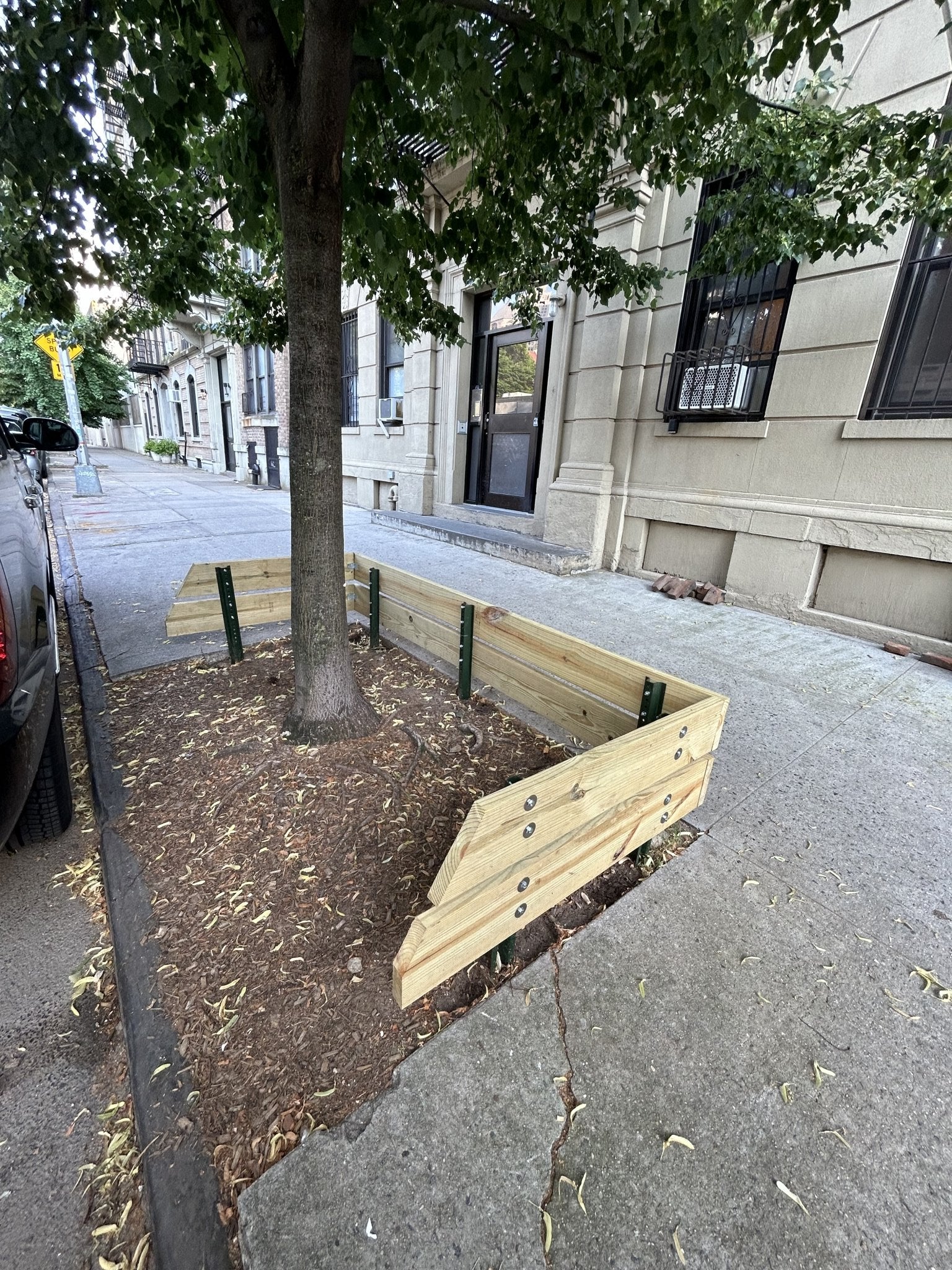
The tree guards protect trees and preserve the soil around sidewalk trees from foot traffic and pet waste. The initiative, which began at the end of 2024, aims to protect urban trees, encourage community involvement and enable stewardship of local green spaces.
One tree guard can protect a sidewalk tree from pedestrians, dogs and cars. Photo Courtesy of Big Reuse
“Our street trees face a lot of stressors. We ask them to do much of their growing not in the forest. They’re growing next to cars. People are walking, and people are out with their dogs,” said Justin Green, the executive director of Big Reuse.
Community through tree protection
The tree guard project offers community members and organizations an opportunity to take ownership of local trees and foster the city’s urban forest in a hands-on way.
The tree guard design features steel signposts and pressure-treated lumber. Photo Courtesy of Big Reuse
The tree guard is designed with steel signposts for durability and pressure-treated lumber for its above-ground frame. The pressure-treated wood is easy to cut to size, making it adaptable to trees of various dimensions. The wooden structure allows for easy replacement if damaged, ensuring longevity. The goals of the design are affordability (one unit costs $275) and accessibility.
Big Reuse, the nonprofit that designed the tree guards and regularly organizes street tree care volunteers, collaborated with NYC Parks officials to improve the tree guard design. The Big Reuse website offers detailed building instructions and resources for acquiring a tree work permit, simplifying the process for residents to build and install their own tree guards.
Councilmember Lincoln Restler. Photo courtesy of Robert London
Restler is funding the installation of 50 new tree guards for District 33 residents or community groups who cannot afford the cost on their own.
“Before the launch of our affordable tree guard model, a New Yorker would typically have to pay between $1000 to $1500 to use one of the previously approved tree guards,” Restler wrote to the Brooklyn Eagle. “That’s far too much money for most New Yorkers to spend on a tree guard. We expect most of these new tree guard installations to be self-funded by neighbors, either as individuals or by coming together as a block.”
Restler has worked with Big Reuse to plan tree care days, and hundreds of volunteers have participated in District 33 over the past few years to help maintain their urban agriculture, according to Restler.
A scene from West Street in Greenpoint, part of the Brooklyn Greenway, after new trees were planted several years ago. Photo courtesy of Brooklyn Greenway Initiative
“We’ve engaged neighbors throughout the process who are excited about this low-cost way to protect trees on their block. Tree guards are essential for keeping street trees healthy, which maximizes their positive impact on our air quality, resiliency and local environment,” wrote Restler.
Big Reuse aims to install 200 tree guards in 2025. Currently, around 40 groups are slated to install the guards.
“If it’s less compacted, it can absorb more water, which is good for the trees and runoff into the streets. That helps make the soil around the tree healthier, which is important for the tree. It will reduce the amount of dogs peeing directly on the tree,” said Green.
City of Forest Day tree planting in Brooklyn Heights. Photo courtesy of Forest for All
Green noted that tree guards also protect the city’s tree canopy from more extreme damage and risks such as car crashes. In one example in Long Island City, Green said, “The tree guard was damaged, but it protected the tree from getting hit by a vehicle.”
The value of an urban forest
The city is investing in a variety of measures to promote the cultivation of its urban forest. An urban forest includes everything from sidewalk trees to park forestry and offers a natural combative measure to climate change.
BBG President Adrian Benepe. Photo by Liz Ligon
“Investments in large-scale tree planting and preservation to sequester carbon, restoration and enhancement of freshwater and saltwater wetlands to slow storm surge and filter the water, etc.” Adrian Benepe, president of the Brooklyn Botanic Garden and a prominent NYC environmental advocate, told the Brooklyn Eagle in January.
The Forest for All Coalition is a group of parks leadership, community groups and environmental advocates who advocate for NYC’s urban forest. According to the coalition, an urban forest supports the city’s efforts to mitigate climate change by providing natural protection from floods, heat and carbon emissions.
NYC Parks Commissioner Sue Donoghue. Photo courtesy of NYC Parks
“New Yorkers rely on trees to provide respite from the heat, mitigate the effects of excess stormwater, and keep our air clean,” said Parks Commissioner Sue Donaghue. “NYC Parks manages over half of the city’s existing tree canopy, with experts in tree care and conservation ensuring their health and continued growth as they expand to cover more area with cooling shade.”
In October 2023, the coalition supported Local Law 148, in which City Council required the city to create an urban forest plan that has to be revisited every 10 years.
In November 2024, the city launched an Urban Forest Plan to increase the city’s tree canopy to 30% by 2035. As part of the plan, NYC Parks plans to plant a tree in every viable spot in the city’s most heat-vulnerable neighborhoods by 2028.
“What’s happened over the last forty years is that we’ve gone from just a few people understanding the value of trees, aside from romantic value, to a huge constituency,” Benepe told the Brooklyn Eagle in 2023. “It’s taken a lot of research to figure out what the city needs to do … So the Natural Areas Conservancy was pushing for this increase to 30% by 2035. I think it makes a lot of sense.”
Initiatives like the tree guards will enable community members to participate in achieving the city’s urban forest goal. Interested residents can sign up for a tree guard here.
Since you're already in Premium Content, please enjoy these related articles:
Brooklyn Botanic Garden announced the winners of the 2022 Greenest Block in Brooklyn contest today at a press conference held on the winning residential block,
SUNSET PARK — “As a resident of Marine Park, one of the great surprises I found biking around Industry City and visiting Japan Village was to discover Bush Terminal Park. I continue to be amazed at the serene hideaways that the city offers in some of the busiest places — and, still, with an iconic view.”
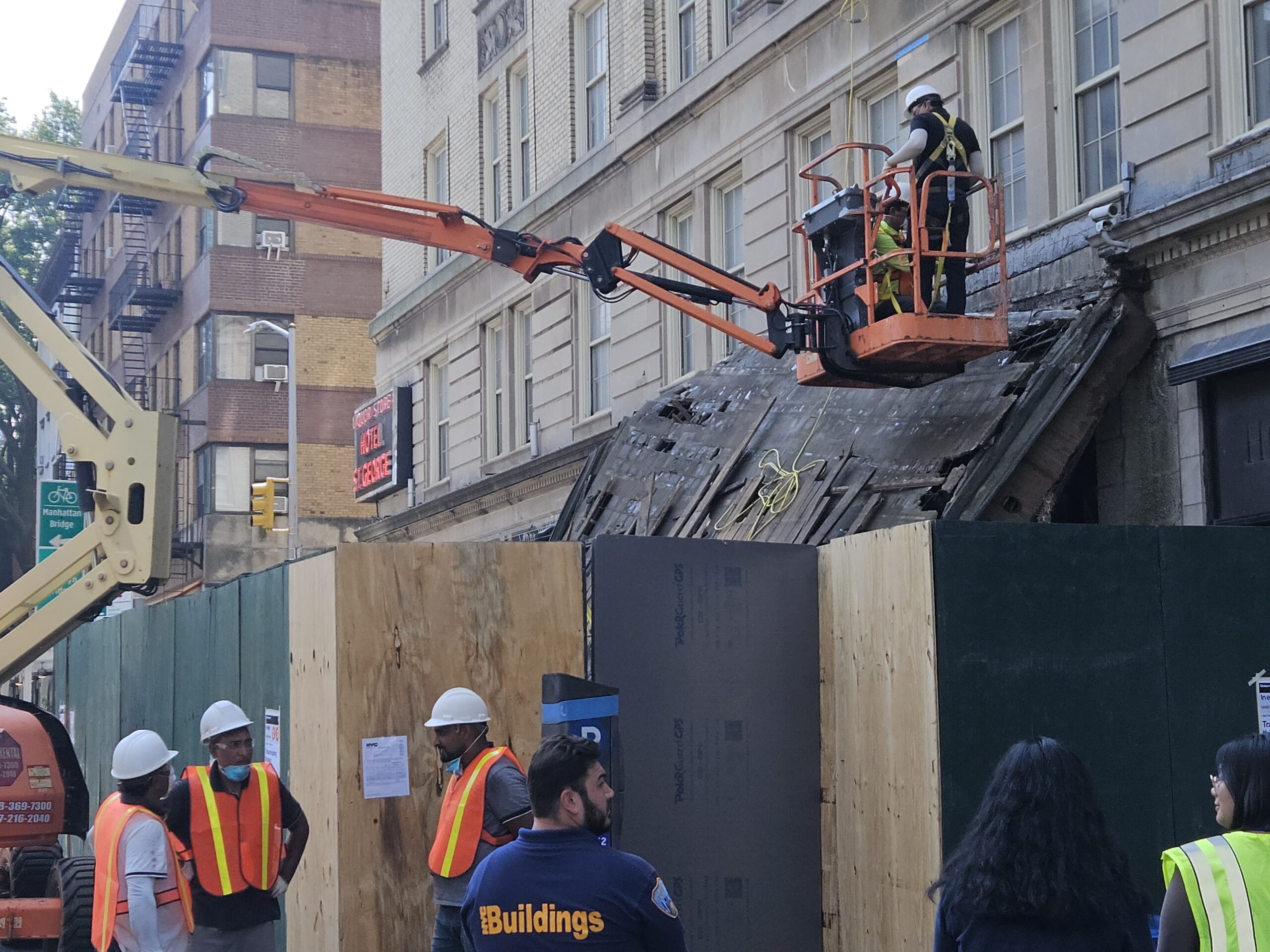
BROOKLYN HEIGHTS — ‘A miracle that no one was killed …’ That’s what neighbors are saying about the collapse of the Hotel St. George marquee. Shown in this photograph are workmen beginning the removal and repair of the historic, old neon sign at the corner, referencing a relic of Brooklyn Heights’ past: the St. George Hotel.
ATLANTIC AVENUE — Exhausted shopper with cluster of bags and goods from mall at Boerum Place stops to look at huge construction site across the street. “Is that REALLY going to be a jail??” Her male companion is reassuring, “Nothing like Rikers … this is 21st Century.”
BROOKLYN HEIGHTS — Overheard in line at one of most popular pastry outlets on Montague Street: “Hope I can get them into a camp …” A mother with two pre-schoolers in tow was showing a friend the Dodge Y flyer for Healthy Kids Day on Saturday, April 18.