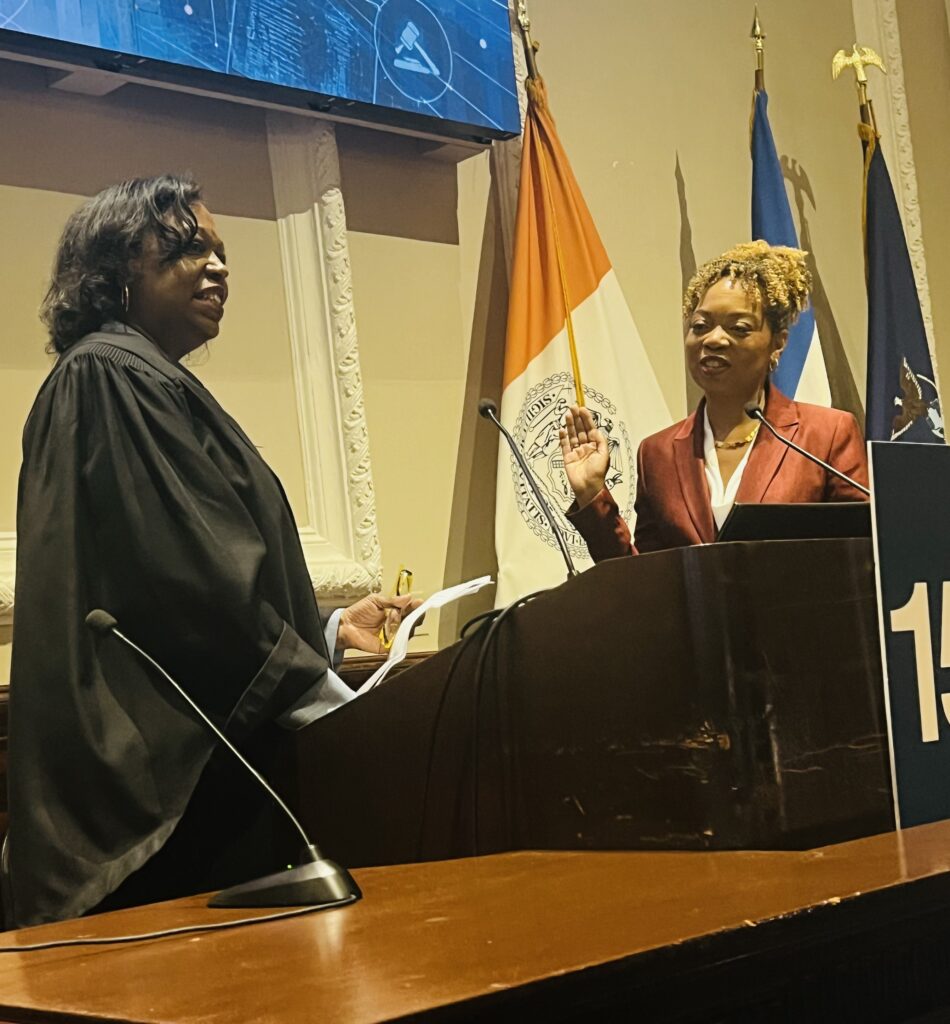
U.S. District Judge Lashann DeArcy Hall last month vacated the sentence of Patrick Spencer, a man previously convicted on multiple counts related to drugs and firearms.
The crux of the issue revolves around the application of the Armed Career Criminal Act (ACCA), a law that enhances sentences for certain types of offenses.
Spencer, who was convicted in 2011 on charges including possession with intent to distribute substances containing cocaine base and heroin, using and carrying a firearm during a drug trafficking crime, and being a felon in possession of a firearm, sought to overturn his conviction and sentence of 300 months. The sentence was so lengthy largely due to four prior convictions deemed as violent felonies.
The recent ruling hinged on two main arguments presented by Spencer.
The first pertains to his previous convictions of attempted armed robbery, which he argued should not be classified as “violent felonies” under ACCA in light of a Supreme Court ruling in United States v. Taylor. That case established that the attempted Hobbs Act robbery did not qualify as a “crime of violence” because it didn’t require proof that the defendant used, threatened to use, or attempted to use force.
Judge Hall ruled that while Spencer’s second-degree attempted armed robbery conviction did not meet the definition of a violent felony, his conviction for first-degree attempted robbery does fall under ACCA’s violent felony category.
The second argument, which proved decisive, was related to Spencer’s conviction for the attempted criminal sale of a controlled substance in the third degree. The defendant argued, and the court agreed, that this conviction was not a “serious drug offense” under ACCA, as it did not align with its federal counterpart. Under the ACCA, a “serious drug offense” must be parallel or narrower than its federal equivalent.
In this case, Spencer’s conviction was based on a New York state law that covered more substances than the federal Controlled Substance Act. Judge Hall noted that New York’s definition of a “narcotic drug” included a wider range of cocaine derivatives than the federal law, rendering it a non-categorical match. This meant that Spencer’s conviction for the third-degree attempted criminal sale of a controlled substance could not be used to enhance his sentence under ACCA.
Judge Hall ultimately agreed with a growing number of courts that there is no categorical match between a controlled substance under federal law and a narcotic drug under New York law, thereby reducing the number of valid predicates that could be used to enhance Spencer’s sentence.
This ruling has vacated Spencer’s sentence, a significant victory for the defendant and a precedent-setting case that could potentially impact ACCA sentencing enhancements going forward.