Process to select chief judge to be reexamined after Dems reject LaSalle
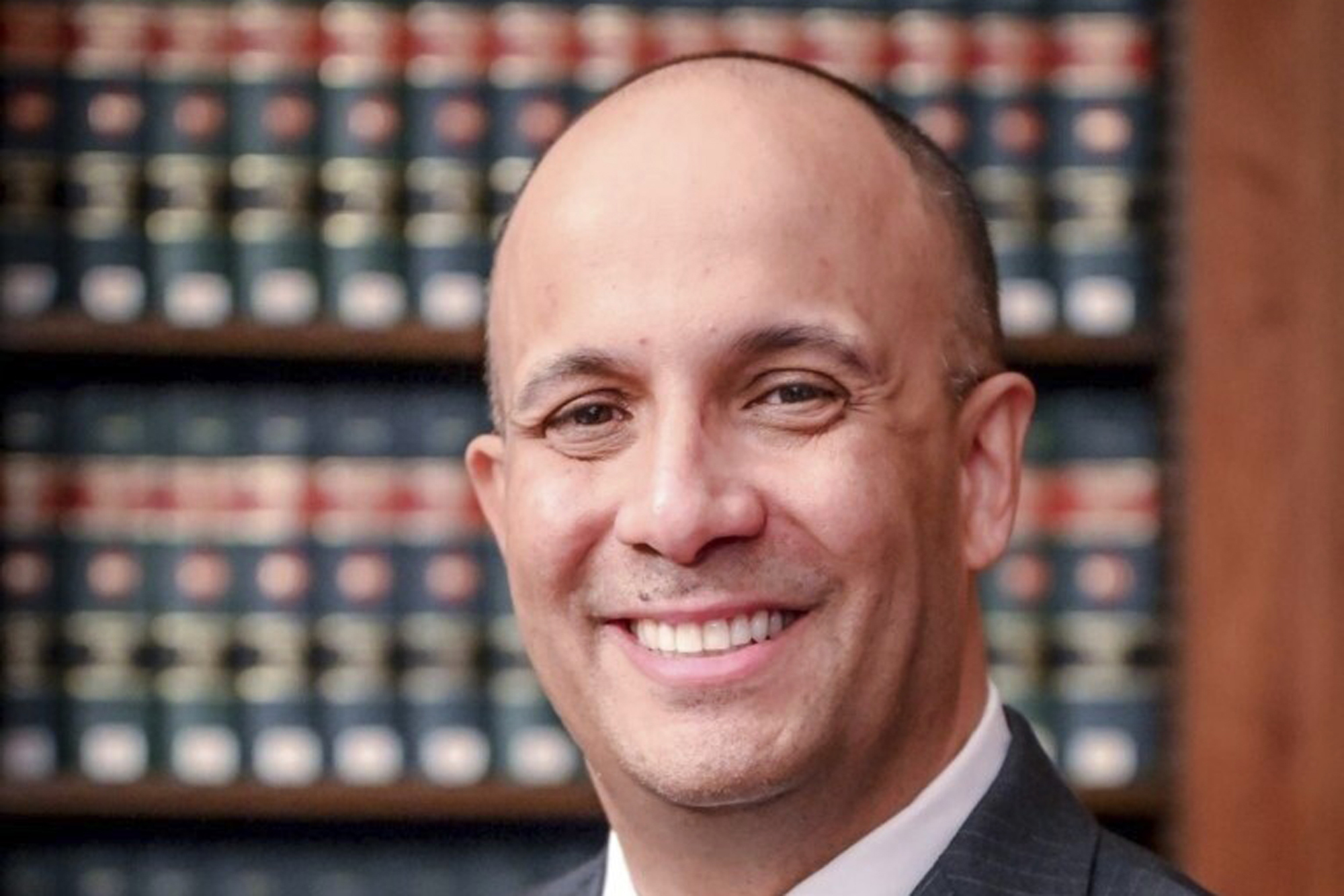
Presiding Justice Hector LaSalle has announced the upcoming roundtable discussion focused on Latinas in leadership, to be held by the Appellate Division, Second Judicial Department. AP file photo
On Wednesday afternoon a group of 10 Democratic State Senators voted to reject Gov. Kathy Hochul’s nomination of Hon. Hector LaSalle as the State’s next top judge.
Almost immediately after that news came out, Sherry Levin Wallach, president of the NYS Bar Association, announced that she will appoint a Special Committee on the Selection of Judges for the Court of Appeals.
“The independence of the judiciary is crucial to the administration of justice,” Levin Wallach said. “The chief judge runs one of the most preeminent court systems in the world and oversees a staff of more than 15,000 people and a budget of about $3 billion. It is of the utmost importance that we have a process that allows the judiciary to operate efficiently and impartially.”
The committee will examine the process and make recommendations to the governor and legislature in response to concerns raised in recent weeks since LaSalle’s nomination.
NYSBA President Sherry Levin Wallach. File photo by Robert Abruzzese
Levin Wallach did not say exactly when the committee will meet, or when she expects it to produce a report or recommendations. However, she said that the plan is to appoint members to the committee immediately with the hope that it will work expeditiously to provide suggestions about the process.
The chief judge of the court of appeals, which is currently Hon. Anthony Cannataro, who is serving in an acting role since the abrupt resignation of Hon. Janet DiFiore last year, is in charge of administering the court system and its budget.
The governor appoints the chief judge from a list of qualified nominees that are submitted via a judicial nomination commission. That judge, who serves a 14-year-term, is voted on by the State Senate, first by the Senate Judiciary Committee, and then, if approved, by the entire State Senate.
Andrew Gounardes, the State Senator from Brooklyn who serves on the judiciary committee, had previously expressed uncertainty regarding LaSalle’s nomination.
“I appreciate the historic nature of Justice Hector LaSalle’s nomination as Chief Judge for the NYS Court of Appeals and believe that our judiciary must reflect the full diversity of our state,” Gounardes told the Brooklyn Eagle after LaSalle’s nomination. “However, I am deeply concerned about Justice LaSalle’s history of prior judicial rulings, including cases where he has ruled in favor of crisis pregnancy centers and made it harder for workers in my district to exercise their legal rights to organize through their union.
“These decisions, among others, do not reflect the values that I think are most fitting for a Chief Judge,” Gounrdes said. “At a time when the conservative bloc on the U.S. Supreme Court is actively undermining Americans’ fundamental and civil rights, the New York judiciary must be a bulwark and beacon in protecting and advancing those same rights. As a member of the Senate Judiciary committee, I will be exercising my responsibility of further reviewing Justice LaSalle’s record and evaluating how his nomination reflects on the Court of Appeals that our state needs.”
LaSalle, who is from Long Island, currently serves as the presiding justice of the Appellate Division, Second Judicial Department, that hears appeals from cases out of Brooklyn, Queens, Staten Island and Long Island. He would have been the first person of Hispanic descent to serve as the chief judge in New York.
Many on the political left have rejected LaSalle’s nomination as the state’s top judge because of his past decisions involving labor unions, reproductive rights organizations, civil rights groups, and community-based organizations.
Writing in the Queens Daily Eagle, Vincent M. Southerland and Jason D. Williamson discussed a specific decision written by LaSalle in the case of People v. Bridgeforth, where they said that LaSalle held that skin-color discrimination in jury selection does not violate constitutional rights. That decision by LaSalle was eventually overturned by the Court of Appeals.
“The opinion Justice LaSalle joined in Bridgeforth ignores the obvious discrimination in the prosecution’s actions,” Sutherland and Williamson wrote. “The prosecutor could not offer a single reason for striking an Indian-American woman from the jury other than her skin color. Yet the justice joined an opinion refusing to find that “skin color” was a class protected by either the federal or state constitutions. One could be rejected from jury service because of the color of their skin. It was an opinion that quite literally did not see color.”
SUNSET PARK — “As a resident of Marine Park, one of the great surprises I found biking around Industry City and visiting Japan Village was to discover Bush Terminal Park. I continue to be amazed at the serene hideaways that the city offers in some of the busiest places — and, still, with an iconic view.”
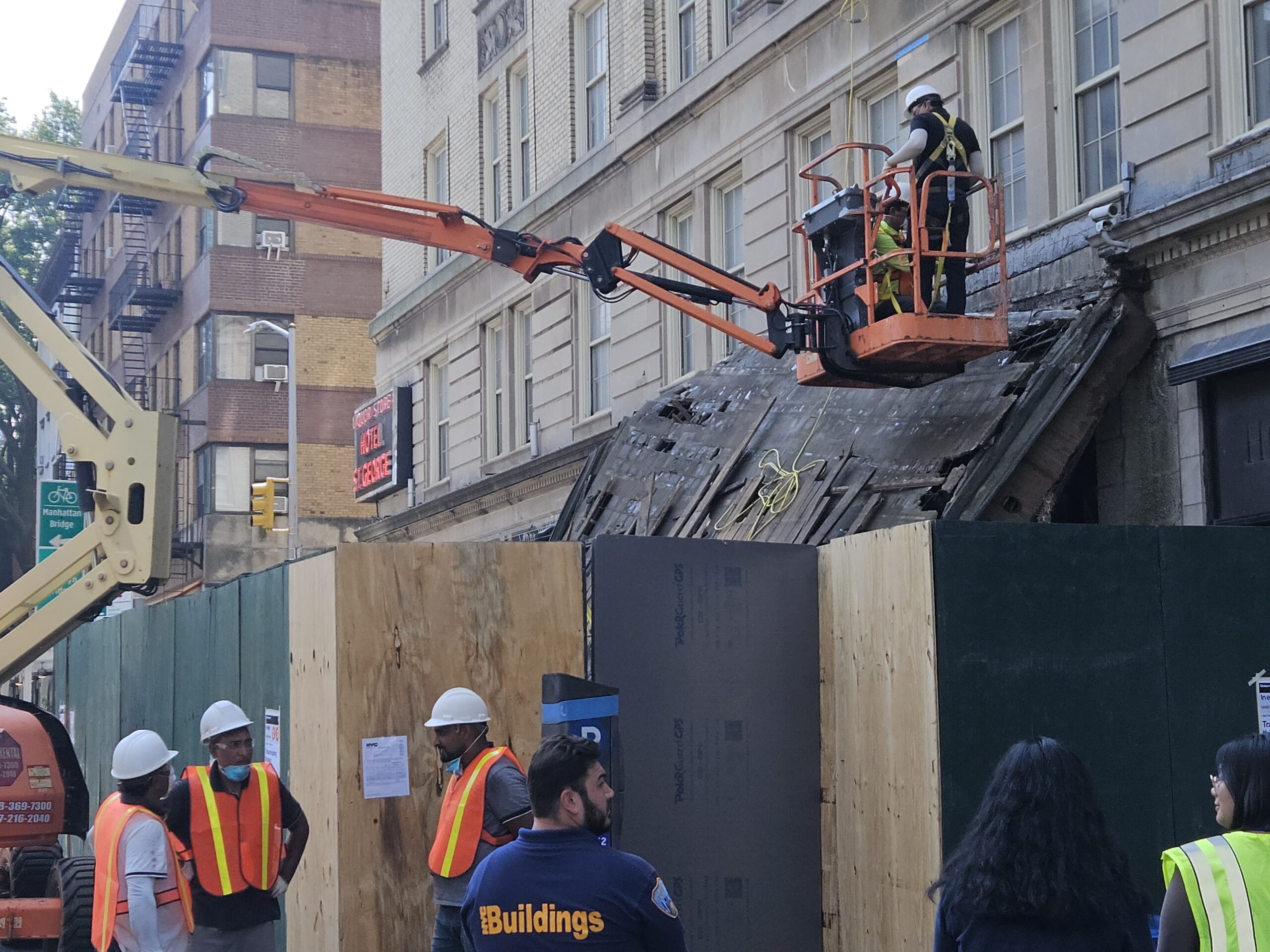
BROOKLYN HEIGHTS — ‘A miracle that no one was killed …’ That’s what neighbors are saying about the collapse of the Hotel St. George marquee. Shown in this photograph are workmen beginning the removal and repair of the historic, old neon sign at the corner, referencing a relic of Brooklyn Heights’ past: the St. George Hotel.
ATLANTIC AVENUE — Exhausted shopper with cluster of bags and goods from mall at Boerum Place stops to look at huge construction site across the street. “Is that REALLY going to be a jail??” Her male companion is reassuring, “Nothing like Rikers … this is 21st Century.”
BROOKLYN HEIGHTS — Overheard in line at one of most popular pastry outlets on Montague Street: “Hope I can get them into a camp …” A mother with two pre-schoolers in tow was showing a friend the Dodge Y flyer for Healthy Kids Day on Saturday, April 18.