Darknet markets generate millions in revenue selling stolen personal data, supply chain study finds
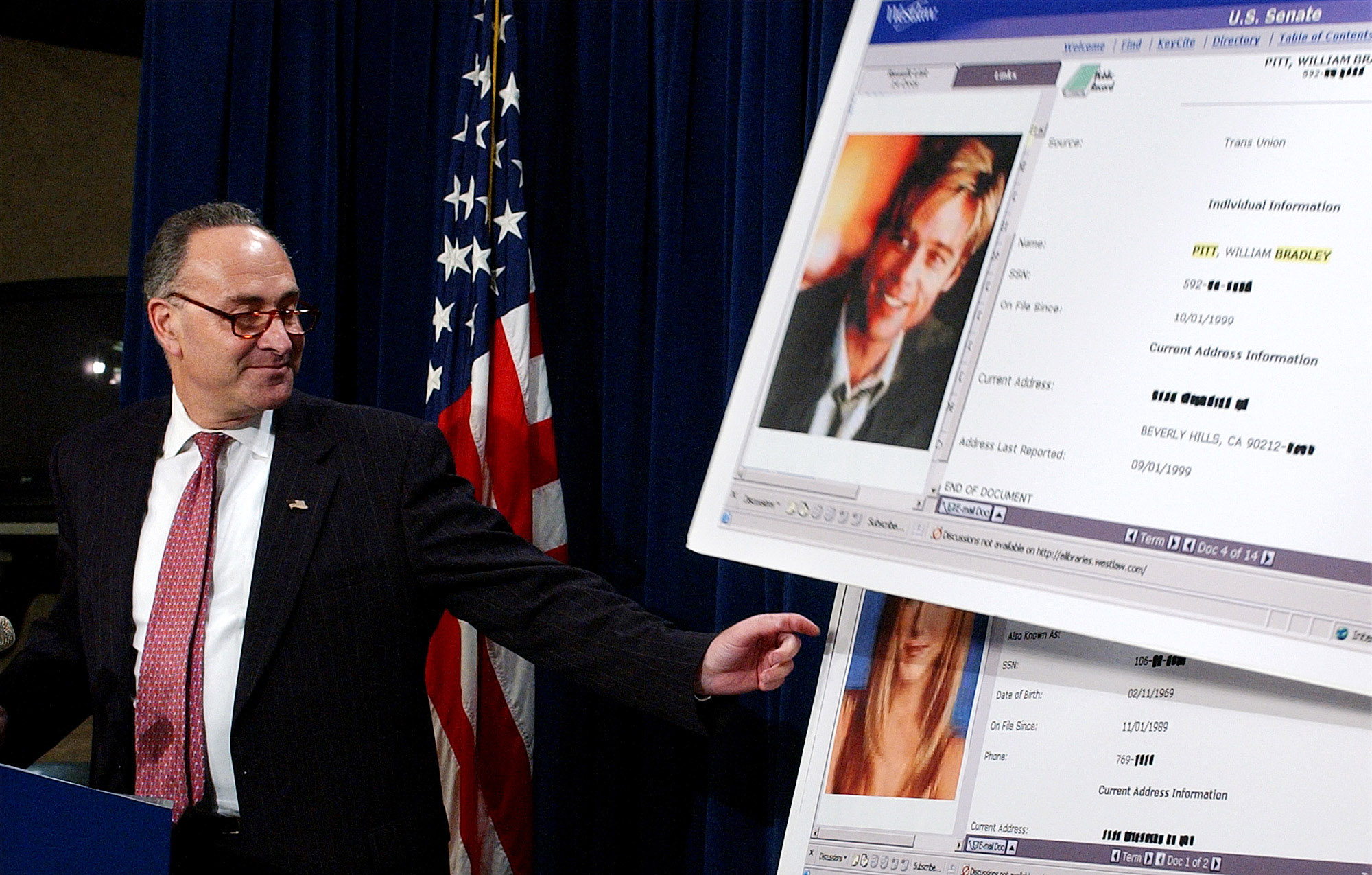
Senator Charles Schumer, D-N.Y., points to posters displaying personal information on Brad Pitt and Jennifer Aniston obtained from Westlaw's Internet-based "People-Find" data base during a news conference on Capitol Hill Thursday, Feb. 24, 2005.
Photo: Dennis Cook/AP
By Christian Jorden Howell and David Maimon, The Conversation
December 3, 2022
Copy Link
Email
Facebook
X
LinkedIn
WhatsApp
Telegram
Pinterest
Print
It is common to hear news reports about large data breaches, but what happens once your personal data is stolen? Our research shows that, like most legal commodities, stolen data products flow through a supply chain consisting of producers, wholesalers and consumers. But this supply chain involves the interconnection of multiple criminal organizations operating in illicit underground marketplaces.
The stolen data supply chain begins with producers – hackers who exploit vulnerable systems and steal sensitive information such as credit card numbers, bank account information and Social Security numbers. Next, the stolen data is advertised by wholesalers and distributors who sell the data. Finally, the data is purchased by consumers who use it to commit various forms of fraud, including fraudulent credit card transactions, identity theft and phishing attacks.
This trafficking of stolen data between producers, wholesalers and consumers is enabled by darknet markets, which are websites that resemble ordinary e-commerce websites but are accessible only using special browsers or authorization codes.
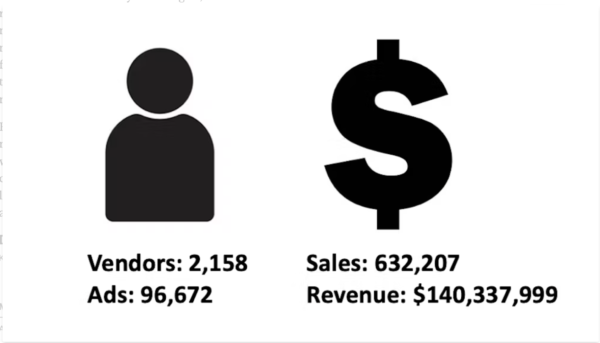
We found several thousand vendors selling tens of thousands of stolen data products on 30 darknet markets. These vendors had more than US$140 million in revenue over an eight-month period.
The size and scope of the stolen data ecosystem over an eight-month period. Photo: Christian Jordan Howell, CC BY-ND
Darknet markets
Just like traditional e-commerce sites, darknet markets provide a platform for vendors to connect with potential buyers to facilitate transactions. Darknet markets, though, are notorious for the sale of illicit products. Another key distinction is that access to darknet markets requires the use of special software such as the Onion Router, or TOR, which provides security and anonymity.
Silk Road, which emerged in 2011, combined TOR and bitcoin to become the first known darknet market. The market was eventually seized in 2013, and the founder, Ross Ulbricht, was sentenced to two life sentences plus 40 years without the possibility of parole. Ulbricht’s hefty prison sentence did not appear to have the intended deterrent effect. Multiple markets emerged to fill the void and, in doing so, created a thriving ecosystem profiting from stolen personal data.
Stolen data ecosystem
Recognizing the role of darknet markets in trafficking stolen data, we conducted the largest systematic examination of stolen data markets that we are aware of to better understand the size and scope of this illicit online ecosystem. To do this, we first identified 30 darknet markets advertising stolen data products.
Next, we extracted information about stolen data products from the markets on a weekly basis for eight months, from Sept. 1, 2020, through April 30, 2021. We then used this information to determine the number of vendors selling stolen data products, the number of stolen data products advertised, the number of products sold and the amount of revenue generated.
In total, there were 2,158 vendors who advertised at least one of the 96,672 product listings across the 30 marketplaces. Vendors and product listings were not distributed equally across markets. On average, marketplaces had 109 unique vendor aliases and 3,222 product listings related to stolen data products. Marketplaces recorded 632,207 sales across these markets, which generated $140,337,999 in total revenue. Again, there is high variation across the markets. On average, marketplaces had 26,342 sales and generated $5,847,417 in revenue.
After assessing the aggregate characteristics of the ecosystem, we analyzed each of the markets individually. In doing so, we found that a handful of markets were responsible for trafficking most of the stolen data products. The three largest markets – Apollon, WhiteHouse and Agartha – contained 58% of all vendors. The number of listings ranged from 38 to 16,296, and the total number of sales ranged from 0 to 237,512. The total revenue of markets also varied substantially during the 35-week period: It ranged from $0 to $91,582,216 for the most successful market, Agartha.
Example of a stolen data ‘product’ sold on a darknet market. Photo: Screenshot by Christian Jordan Howell, CC BY-ND
For comparison, most midsize companies operating in the U.S. earn between $10 million and $1 billion annually. Both Agartha and Cartel earned enough revenue within the 35-week period we tracked them to be characterized as midsize companies, earning $91.6 million and $32.3 million, respectively. Other markets like Aurora, DeepMart and WhiteHouse were also on track to reach the revenue of a midsize company if given a full year to earn.
Our research details a thriving underground economy and illicit supply chain enabled by darknet markets. As long as data is routinely stolen, there are likely to be marketplaces for the stolen information.
These darknet markets are difficult to disrupt directly, but efforts to thwart customers of stolen data from using it offers some hope. We believe that advances in artificial intelligence can provide law enforcement agencies, financial institutions and others with information needed to prevent stolen data from being used to commit fraud. This could stop the flow of stolen data through the supply chain and disrupt the underground economy that profits from your personal data.
Christian Jordan Howell is an assistant professor in cybercrime at the University of South Florida. David Maimon is a professor of criminal justice and criminology at Georgia State University.
SUNSET PARK — “As a resident of Marine Park, one of the great surprises I found biking around Industry City and visiting Japan Village was to discover Bush Terminal Park. I continue to be amazed at the serene hideaways that the city offers in some of the busiest places — and, still, with an iconic view.”
BROOKLYN HEIGHTS — ‘A miracle that no one was killed …’ That’s what neighbors are saying about the collapse of the Hotel St. George marquee. Shown in this photograph are workmen beginning the removal and repair of the historic, old neon sign at the corner, referencing a relic of Brooklyn Heights’ past: the St. George Hotel.
ATLANTIC AVENUE — Exhausted shopper with cluster of bags and goods from mall at Boerum Place stops to look at huge construction site across the street. “Is that REALLY going to be a jail??” Her male companion is reassuring, “Nothing like Rikers … this is 21st Century.”
BROOKLYN HEIGHTS — Overheard in line at one of most popular pastry outlets on Montague Street: “Hope I can get them into a camp …” A mother with two pre-schoolers in tow was showing a friend the Dodge Y flyer for Healthy Kids Day on Saturday, April 18.