Kathleen Sweet, president of the New York State Bar Association, issued a public statement on Friday on the posthumous admission of Ely S. Parker to the New York Bar.
Sweet’s statement followed last week’s admission ceremony in Buffalo, where Parker’s legal legacy was formally recognized.
Sweet said the admissions “corrects a longstanding injustice” and recognizes a man who “was a lawyer in every sense of the word,” despite being barred from the profession in his lifetime because he was Native American.
Her remarks underscored the bar association’s public acknowledgment of Parker’s exclusion and its endorsement of the decision to correct it,
“The posthumous admission of Ely S. Parker to the New York Bar today corrects a longstanding injustice,” Sweet said. “Parker wrote the final draft of the Confederate surrender terms at Appomattox and was a lawyer in every sense of the word.”
As a Native American, Parker couldn’t be a citizen or a counselor at law. “Finally, he has received this overdue recognition,” she added.
Parker, a Tonawanda Seneca born in 1828, read law in Ellicottville as a teenager and prepared for the profession in the same way most white candidates did at the time. He drafted documents, studied under an attorney and was, by the early 1850s, deeply involved in legal advocacy for the Seneca Nation.
Ely Parker, the Tonawanda Seneca statesman and Civil War officer whose posthumous admission has prompted lawyers, historians and Seneca leaders to revisit the work he carried out despite that exclusion. Photo courtesy of the National Archives
When he applied for admission in 1849, the New York courts held that only natural-born or naturalized citizens could practice law. As a Seneca, he was neither, and his petition was rejected.
That denial did not stop him from doing the work lawyers do.
Parker became a central figure in the decades-long battle to preserve Tonawanda land rights.
Working with attorney John Martindale, he helped bring cases that reached the U.S. Supreme Court, resulting in two rare victories for Native plaintiffs in the mid-19th century and enabling the Senecas to buy back thousands of acres.
Seneca leaders have long credited those decisions with preserving the community’s home territory.
Even outside of that litigation, the legal work remained central to his life.
His skill as a writer and advocate compelled Ulysses S. Grant to bring him onto his Civil War staff. Parker served as Grant’s military secretary and wrote out the final terms of the Confederate surrender at Appomattox.
He later became the first Native American Commissioner of Indian Affairs.
Parker’s descendants and Seneca officials said last week that the formal recognition brings his record into alignment with the work he actually performed.
Parker died in 1895, nearly 30 years before most Native Americans were recognized as citizens under the 1924 Indian Citizenship Act. Under today’s rules, the basis for his exclusion would not exist.
Parker’s posthumous induction places his name alongside a small group of candidates admitted long after their deaths who were rejected due to racial discrimination.
Legal scholars say Parker is the first Native American to be posthumously admitted to any state bar in the United States.
For advocates who pushed for the recognition, the announcement affirms that Parker had already lived the life of a lawyer, even if the law refused to acknowledge him.
SUNSET PARK — “As a resident of Marine Park, one of the great surprises I found biking around Industry City and visiting Japan Village was to discover Bush Terminal Park. I continue to be amazed at the serene hideaways that the city offers in some of the busiest places — and, still, with an iconic view.”
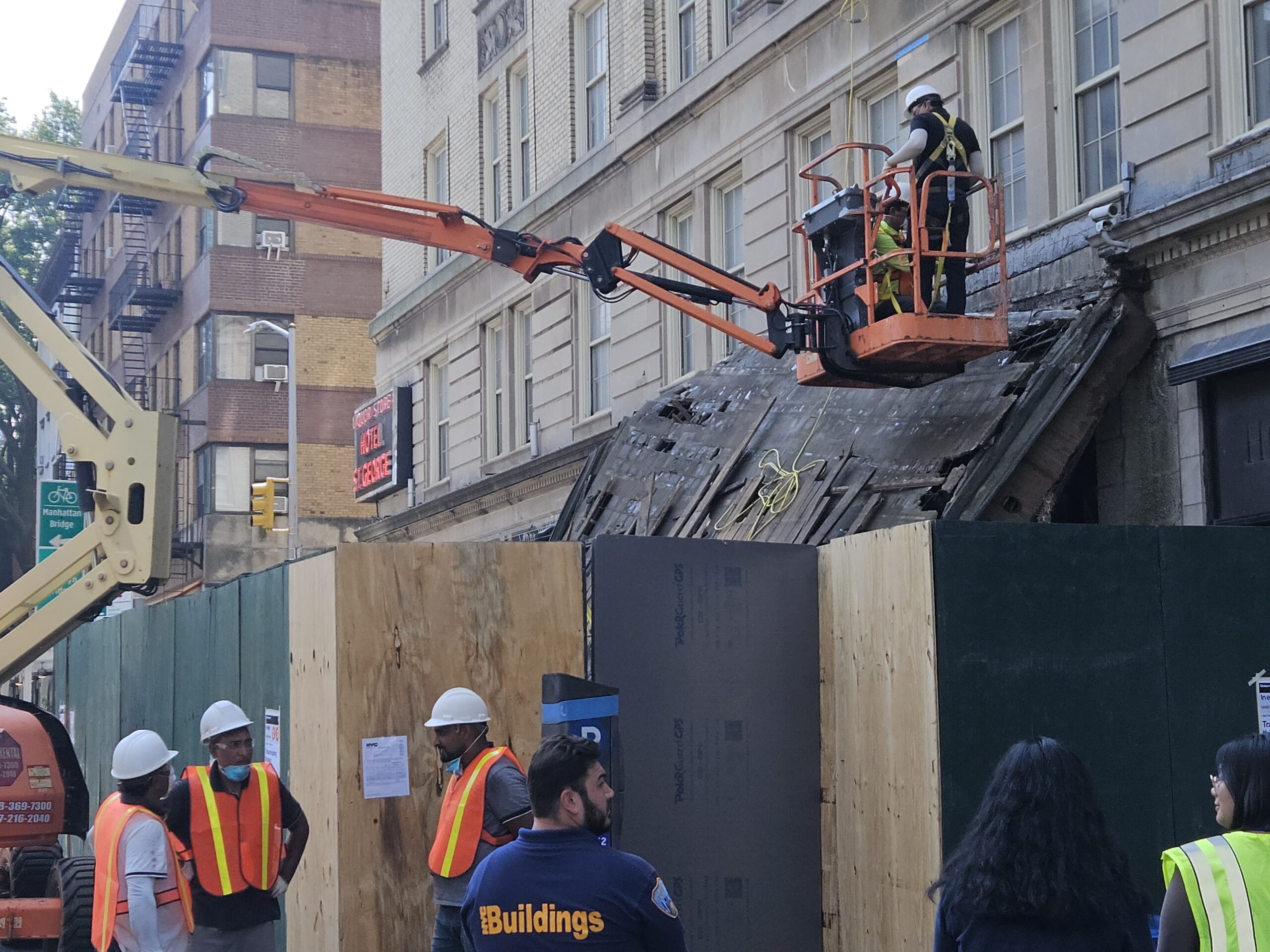
BROOKLYN HEIGHTS — ‘A miracle that no one was killed …’ That’s what neighbors are saying about the collapse of the Hotel St. George marquee. Shown in this photograph are workmen beginning the removal and repair of the historic, old neon sign at the corner, referencing a relic of Brooklyn Heights’ past: the St. George Hotel.
ATLANTIC AVENUE — Exhausted shopper with cluster of bags and goods from mall at Boerum Place stops to look at huge construction site across the street. “Is that REALLY going to be a jail??” Her male companion is reassuring, “Nothing like Rikers … this is 21st Century.”
BROOKLYN HEIGHTS — Overheard in line at one of most popular pastry outlets on Montague Street: “Hope I can get them into a camp …” A mother with two pre-schoolers in tow was showing a friend the Dodge Y flyer for Healthy Kids Day on Saturday, April 18.