Village Preservation, a nonprofit community organization, released a report on Wednesday, which looks at city-initiated neighborhood rezonings over the last two decades and the actual outcomes as compared to the projections made by the city’s Department of City Planning.
The study found that the city’s predictions were almost always wildly off-base, including on key issues that were often the basis for these neighborhood rezonings, such as the amount of housing that would be produced, the amount of affordable housing that would be created, the ratio of commercial to residential development, the impact on retail uses, and the size and location of new developments.
The study found that the accuracy rate of City’s projections rarely reached 50% — the rate a coin toss or a random guess on average would produce. In rezonings including East Midtown, Jerome Avenue, and East Harlem, the city’s projections actually had a 0% accuracy rate.
In East New York, it ranged between 3.42 and 18.3%; in the East Village/Lower East Side, it ranged between 18.6 and 39%; and in Downtown Brooklyn, it ranged between 1.2 and 20% accuracy.
In Long Island City and Hudson Square, the City grossly misestimated the amount and ratio of residential and commercial development, with 95% of the development in Long Island City taking place on sites where the City projected no development taking place.
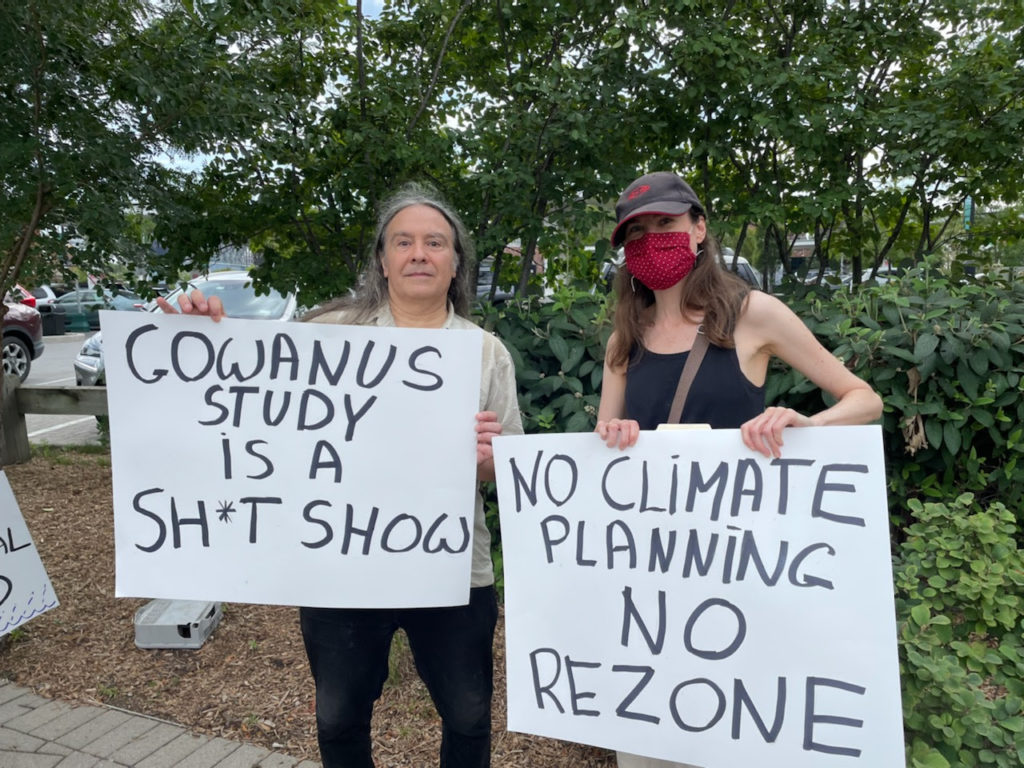
These two people showed exactly what they think of the Gowanus rezoning plan’s environmental impact statement. Photo courtesy of Voice of Gowanus
“Time and again, the city has entirely missed the mark when making predictions about the effects of their neighborhood rezonings, failing to accurately convey to New Yorkers what the true impact of these dramatic proposed changes would be,” said Executive Director Andrew Berman of Village Preservation.
“What’s particularly disturbing is how inaccurate their predictions are about the exact bases for which they argue for these rezonings — how much housing they will create; how much retail space they will produce; how they will add new supermarkets or office space; and how they will increase affordable housing,” Berman said. “In nearly every case, the city’s predictions were less reliable than a literal stab in the dark; one would have a better chance of getting an accurate picture of the results of the city’s rezonings by consulting a storefront fortune teller, or simply flipping a coin.”
These completely mistaken projections are particularly relevant as the City Council considers the Mayor’s proposed SoHo/NoHo/Chinatown rezoning based on the promise of it producing 3,500 units of housing, 900 of them affordable, when independent analysis shows that it is actually likely to produce little if any affordable housing (see also here).
SUNSET PARK — “As a resident of Marine Park, one of the great surprises I found biking around Industry City and visiting Japan Village was to discover Bush Terminal Park. I continue to be amazed at the serene hideaways that the city offers in some of the busiest places — and, still, with an iconic view.”
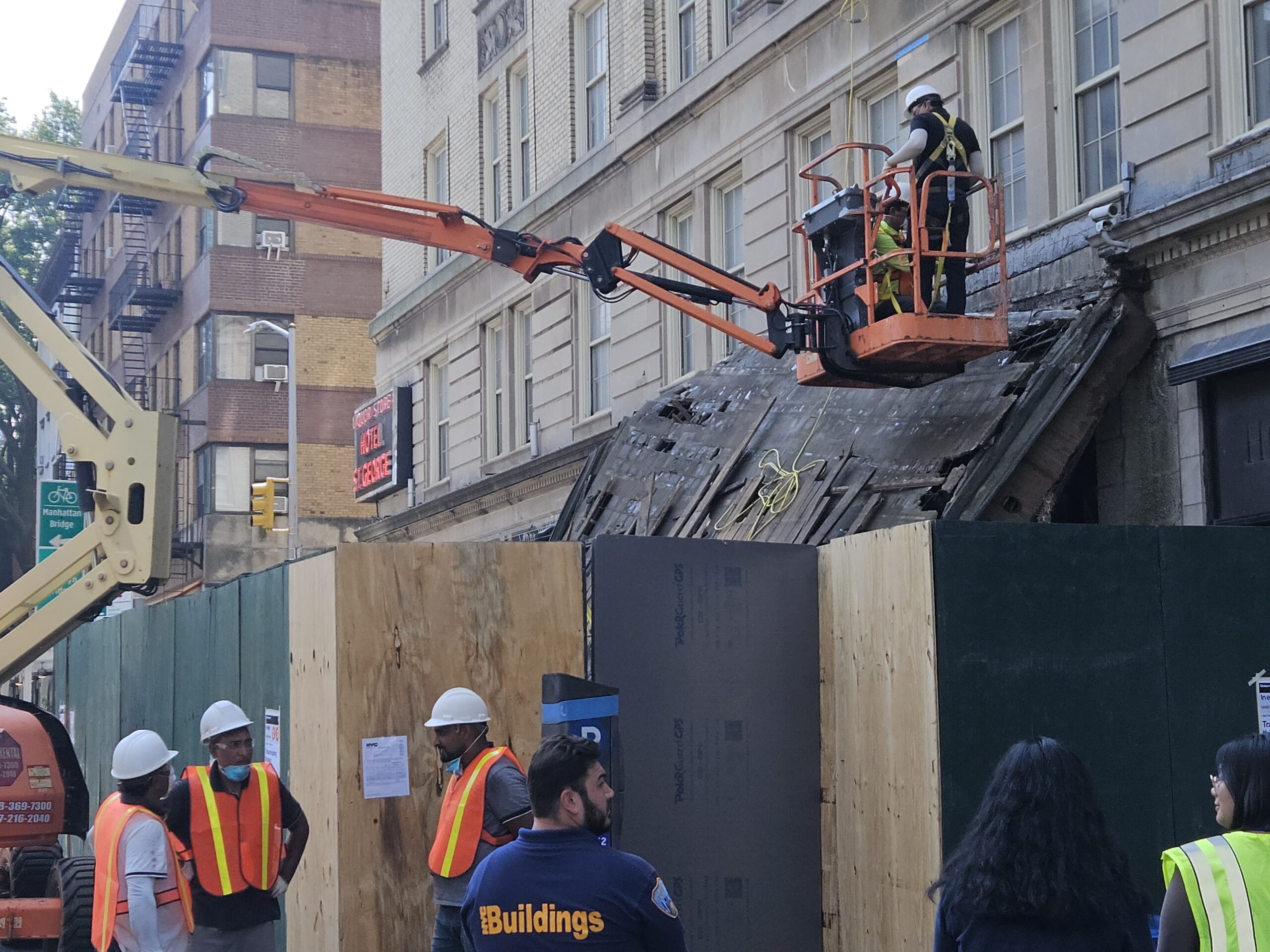
BROOKLYN HEIGHTS — ‘A miracle that no one was killed …’ That’s what neighbors are saying about the collapse of the Hotel St. George marquee. Shown in this photograph are workmen beginning the removal and repair of the historic, old neon sign at the corner, referencing a relic of Brooklyn Heights’ past: the St. George Hotel.
ATLANTIC AVENUE — Exhausted shopper with cluster of bags and goods from mall at Boerum Place stops to look at huge construction site across the street. “Is that REALLY going to be a jail??” Her male companion is reassuring, “Nothing like Rikers … this is 21st Century.”
BROOKLYN HEIGHTS — Overheard in line at one of most popular pastry outlets on Montague Street: “Hope I can get them into a camp …” A mother with two pre-schoolers in tow was showing a friend the Dodge Y flyer for Healthy Kids Day on Saturday, April 18.